SaaS MVP Development Cost in 2026: Full Breakdown

Saas mvp development cost typically lands somewhere between $8,000 and $150,000 or more, and the width of that range is not random.
It is set by how many features you build, where your development team sits, and whether your product carries a regulatory compliance requirement.
If you are a founder, CTO, or product lead scoping a build before you request vendor quotes, this guide breaks down what actually drives that number and where founders most often get the estimate wrong.
For a deeper look at budgeting across the full product lifecycle, not just the MVP phase, see our guide on MVP Development Cost for Startups.
This article covers cost by complexity tier, by feature, by region, and by team type.
It also covers the hidden costs vendors rarely mention upfront, two real cost outcomes worth learning from, and a step-by-step framework for building your own budget before you talk to a development partner.
Quick Answer: Average SaaS MVP Cost by Complexity Tier
| Tier | Cost Range | Timeline | Example Product |
|---|---|---|---|
| Simple | $8,000 – $25,000 | 4 – 6 weeks | Single-feature SaaS tool, basic auth and dashboard |
| Medium | $25,000 – $55,000 | 6 – 10 weeks | Multi-role SaaS with payments and integrations |
| Complex | $55,000 – $150,000+ | 10 – 18 weeks | Multi-tenant platform with compliance or AI features |
Other industry sources report a wider ceiling for compliance-heavy or highly custom builds, with some complex projects reaching $250,000 or more.
Use this table as a starting benchmark, not a final quote.
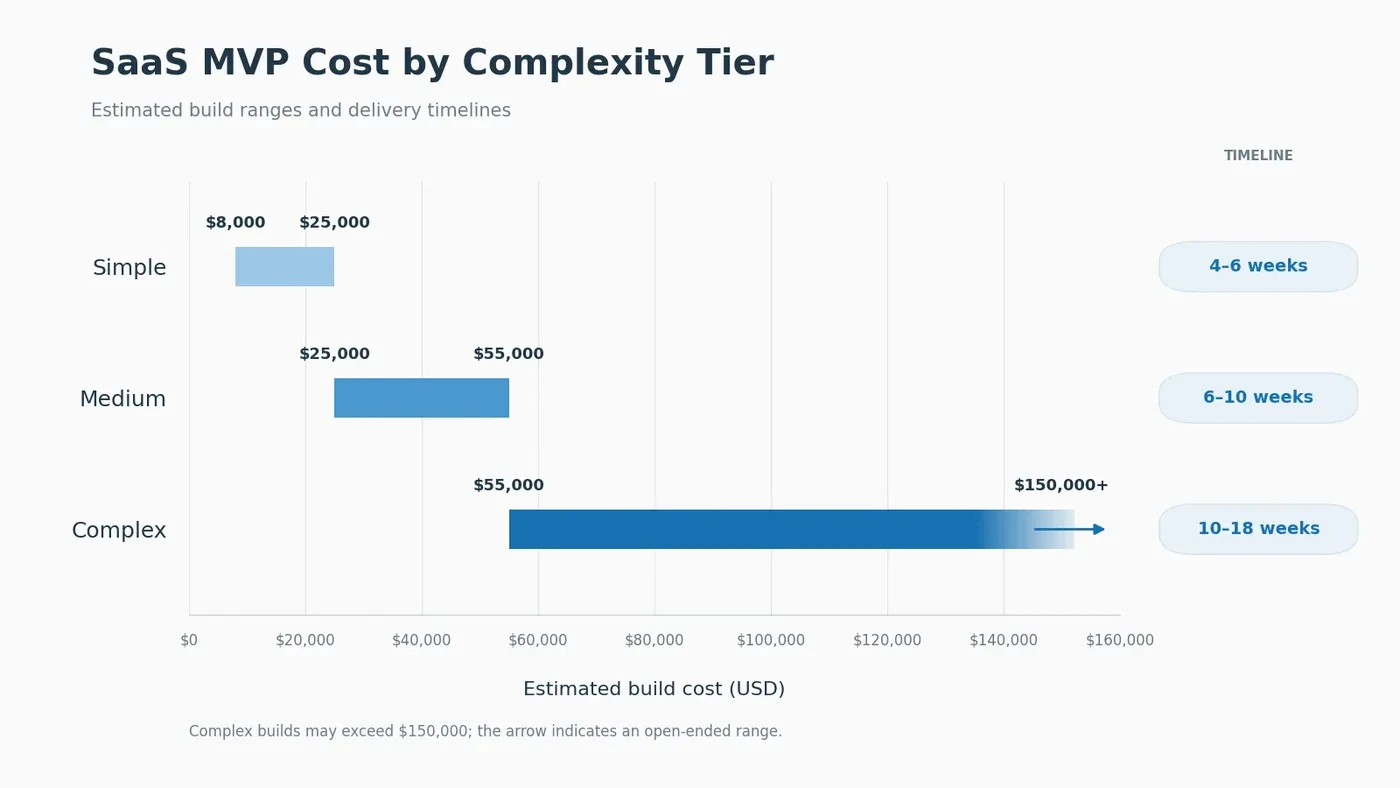
The tier your project lands in is a function of the factors covered next, not the number of screens you’re planning.
What Counts as a SaaS MVP?
SaaS MVP: A production-quality software product that includes only the features needed to validate one core assumption with real, paying users.
It is not a clickable prototype, and it is not a full-featured version 1.0. A proof of concept proves that something can technically work. An MVP proves that people will actually pay for it.
This is the same principle Eric Ries described in the Lean Startup methodology: early product versions should be lean enough to validate one key assumption quickly, rather than attempting to prove the entire product vision at once. Most cost overruns trace back to a team quietly abandoning this definition partway through the build.
What Actually Drives SaaS MVP Cost (6 Key Factors)
1. Feature Complexity and Number of User Roles
Every additional feature adds design, development, testing, and maintenance work.
A single-role tool with basic CRUD functionality is inexpensive.
A multi-tenant platform with role-based permissions, real-time notifications, and multiple integrations is not.
For a marketing or AdTech SaaS product, adding campaign tracking and reporting roles on top of a basic dashboard increases both scope and cost in a way that’s easy to underestimate during initial planning.
2. Tech Stack and Platform Choice
Standard, well-supported technologies such as Node.js or React reduce cost because of a larger talent pool and more available libraries.
Niche technologies can drive up hiring costs and development time due to smaller talent pools.
3. Design Depth
A SaaS product with a polished, custom interface can require three to six weeks of design work before a single line of code is written.
Using existing component libraries instead of fully custom UI work reduces this cost significantly.
4. Compliance Requirements
Products in healthcare, fintech, or insurance carry compliance as a build requirement, not a post-launch concern.
A healthcare MVP needs encrypted data storage and HIPAA-eligible infrastructure before a single patient interaction occurs.
A fintech MVP handling real money needs PCI-DSS compliance from day one, and many B2B SaaS buyers now expect SOC 2 readiness before they’ll even trial a product handling their data.
These security and compliance layers typically add 25 to 40 percent to the total build cost.
5. Team Composition
Cost isn’t just an hourly rate multiplied by hours.
A full build team typically includes a product manager, a designer, frontend and backend developers, a DevOps engineer, and QA.
Vendors who quote significantly below market rate are often missing one of these roles entirely, usually DevOps or dedicated QA, which shows up later as slower releases or more post-launch bugs rather than as a line item you can catch upfront.
6. Team Location
Hourly rates vary significantly by region, and this is often the single biggest lever on total cost.
A senior full-stack developer in Eastern Europe, running for six to eight weeks, costs roughly $20,000 to $35,000.
The same engagement at US rates runs $50,000 to $80,000, for comparable output.
The region section below breaks this down further and explains why location is not the only variable worth optimizing for.
SaaS MVP Cost Breakdown by Feature
| Requirement | Cost Impact |
|---|---|
| Core SaaS features (auth, payments, dashboard, admin panel, API, email) at simple complexity | $35,000 – $80,000 to build from scratch |
| AI or GenAI features (RAG, chat, copilots) | Adds 15–30% to the total budget Ideas2IT, 2026 |
| Compliance requirements (HIPAA, SOC 2, PCI-DSS, GDPR) | Adds 25–40% to the total budget |
| Cross-platform framework (React Native, Flutter) instead of native builds | Can reduce cost by up to 30% |
An e-commerce SaaS tool adding a payment gateway and inventory sync sits closer to the higher end of the core feature range. A simple internal marketing dashboard with no third-party integrations sits closer to the lower end.
SaaS MVP Development Cost by Region
| Region | Hourly Rate | Total MVP Cost |
|---|---|---|
| United States | $71 – $150+/hr | $150,000 – $250,000 |
| Western Europe | $60 – $120/hr | $120,000 – $200,000 |
| Eastern Europe | $25 – $60/hr | $60,000 – $120,000 |
| India | $18 – $40/hr (avg. $32) | $40,000 – $90,000 |
Why India Is a Cost-Effective Option for SaaS MVP Development
Indian developer hourly rates typically range from $20 to $45, a 60 to 80 percent reduction compared to US rates of $100 to $250 for comparable expertise.
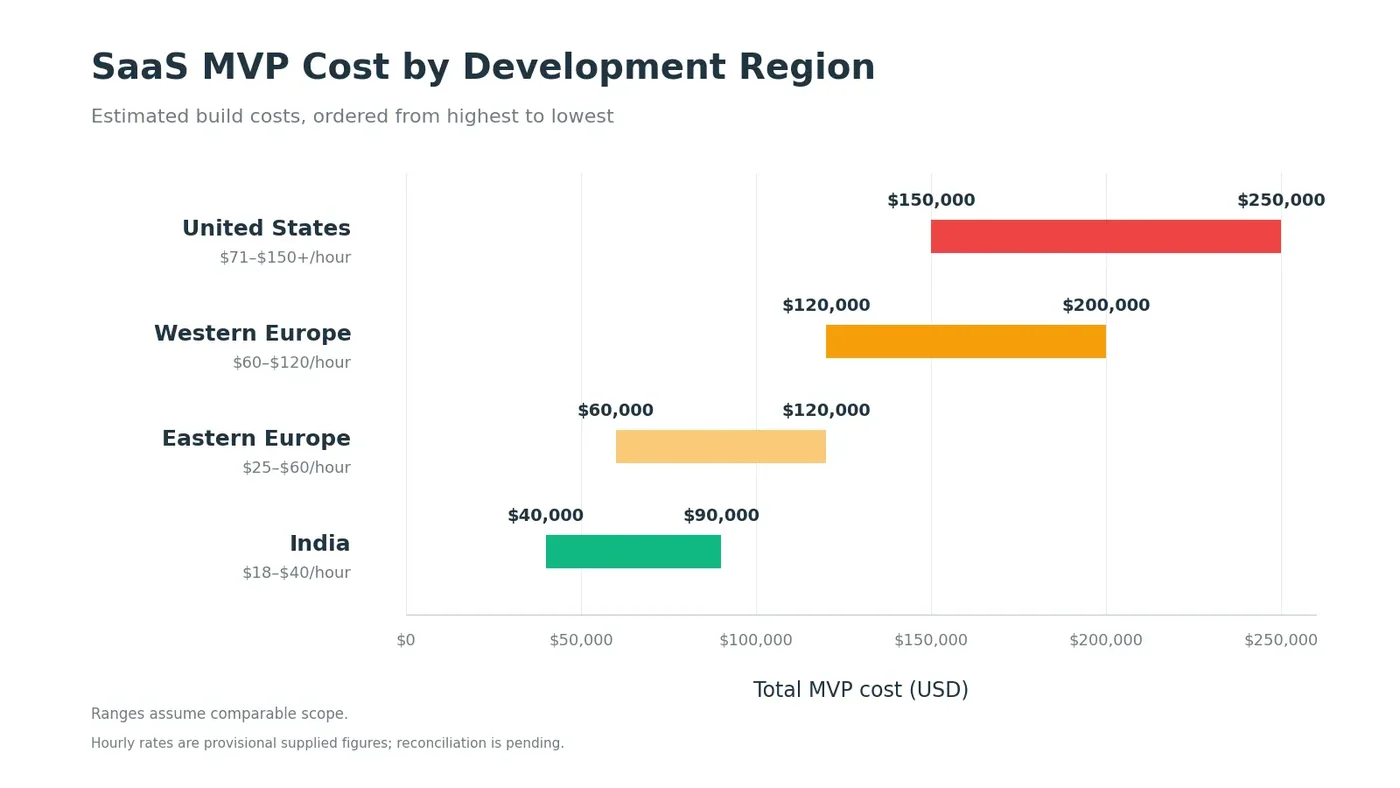
In practical terms, a SaaS MVP with basic authentication, a dashboard, and API integrations that costs around $120,000 in the US can be achievable for around $40,000 in India, assuming disciplined scope control and strong project management.
This is not purely a rate difference.
India’s outsourcing ecosystem has over two decades of maturity, strong English proficiency, and enough timezone overlap with UAE, European, and East Coast US working hours to support structured async communication without major delivery gaps.
That said, region is the wrong first question to optimize.
A well-scoped $40,000 build in India will consistently beat a poorly-scoped $150,000 build in the US, and a poorly-scoped build costs too much regardless of where you hire.
The next section shows what that looks like in practice. For a closer look at how outsourcing partners compare on more than price, see our breakdown of top software development outsourcing companies.
In-House vs. Freelancer vs. Agency: Cost Comparison
| Approach | Typical Cost | Best For |
|---|---|---|
| DIY with starter kit | $1,000 – $10,000 | Technical founders with a clear vision and coding ability |
| Freelancer(s) | $20,000 – $60,000 | Founders needing flexible scope with hands-on management |
| Agency | $50,000 – $250,000 | Funded startups needing full-cycle delivery and accountability |
DIY with a starter kit is the cheapest path but assumes you can code, have a clear product vision, and want to validate before investing heavily.
Freelancers offer flexibility and lower rates than agencies but require more hands-on project management from you, and quality varies by individual, which is exactly where the missing-role risk from the team composition factor above tends to show up.
Agencies cost the most but deliver a tested, professionally managed build with accountability built into the process, which matters more as feature complexity or compliance requirements increase.
For a closer look at how agencies differ on scope and delivery model, see our guide to best software development agencies for custom enterprise applications.
Hidden Costs Founders Often Miss
A development quote is rarely your total budget. Plan for these on top of the build:
- Infrastructure: Hosting, database, CDN, and monitoring typically run $100 to $500 per month at MVP scale.
- Core third-party services: Hosting platforms like Vercel run $20 to $50 per month at low traffic. Database services like Supabase run $25 to $100 per month. Authentication providers like Auth0 or Clerk range from free to $200 per month depending on active users. Transactional email tools run $10 to $50 per month.
- Legal basics: Terms of Service, Privacy Policy, and GDPR compliance documentation if you are targeting European users.
- Post-launch support: Bug fixes, performance issues, and early iteration in the first three months after launch.
As a planning rule, add roughly 30 percent to your development estimate to cover these hidden costs. If your development budget is $50,000, plan for closer to $65,000 in total.
How to Estimate Your Own SaaS MVP Budget (Step-by-Step)
- Define your riskiest assumption. Identify the one thing that could make or break your product, not your full feature wishlist.
- Prioritize using MoSCoW. Sort every feature into must-have, should-have, could-have, and won’t-have for this version.
- Match your must-have list to a complexity tier. Use the tier table above as your starting benchmark.
- Price your team option. Compare DIY, freelancer, and agency costs against your must-have scope, and factor in region if you are considering outsourcing.
- Add a 30 percent buffer. This covers the hidden costs outlined above, plus unavoidable scope adjustments.
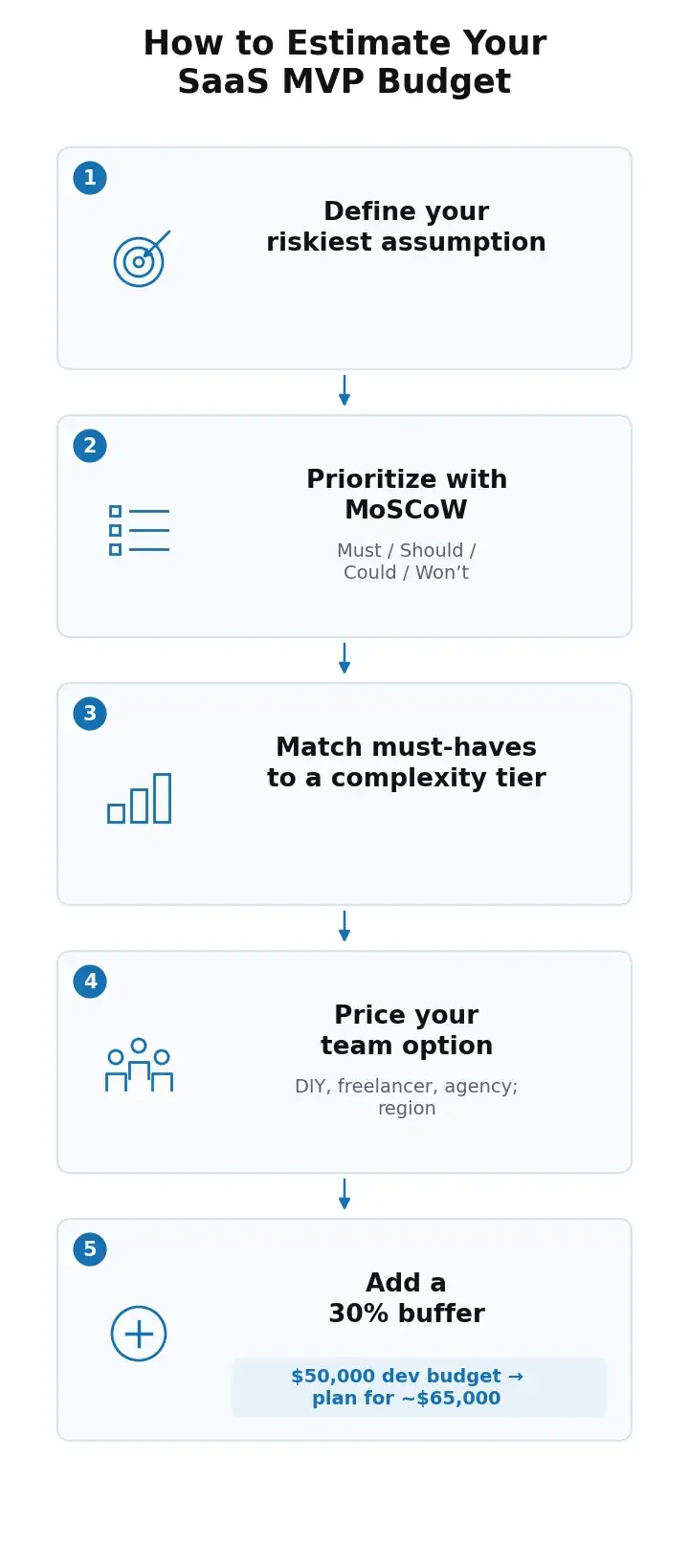
This is the SaaS-specific quick version of the framework. For a full breakdown of estimating software development cost across project types, not just MVPs, see MVP Development Cost for Startups.
How to Reduce SaaS MVP Development Cost Without Cutting Corners
Cut features that don’t test your core assumption.
If a feature isn’t needed to validate your hypothesis, defer it. Every unnecessary feature adds direct development and testing cost.
Use ready-made tools instead of building from scratch.
Integrating an existing authentication or payment provider is faster and cheaper than custom-building the same functionality.
Choose cross-platform frameworks where relevant.
Building with React Native or Flutter instead of separate native iOS and Android apps can cut costs by up to 30 percent.
Use AI-assisted development tooling.
Copilot-class tools can cut 10 to 20 percent of routine development hours when used with proper governance, though they do not replace senior engineering judgment on architecture or security.
Don’t underhire to save money upfront.
One MVP developer’s account of over 50 project engagements includes a specific, cautionary pattern: founders who hire a junior developer to save money often end up paying for a full rebuild once the MVP fails to scale or ships with structural problems, at roughly 3x the original cost and 6 months longer than if they had started with a senior developer. Cheaper hourly rates only save money if the output doesn’t need to be redone.
SaaS MVP Development Timeline
| Tier | Timeline |
|---|---|
| Simple | 4 – 6 weeks |
| Medium | 6 – 10 weeks |
| Complex | 10 – 18 weeks |
Use this table to sanity-check vendor quotes. A quote that promises complex-tier features on a simple-tier timeline is a scope or staffing red flag worth asking about directly.
Real-World Cost Scenarios: What Actually Happens
Scenario 1: A disciplined medium-tier build.
A reported case study from IndianAppDevelopers shows how a medium-tier SaaS MVP budget breaks down in practice.
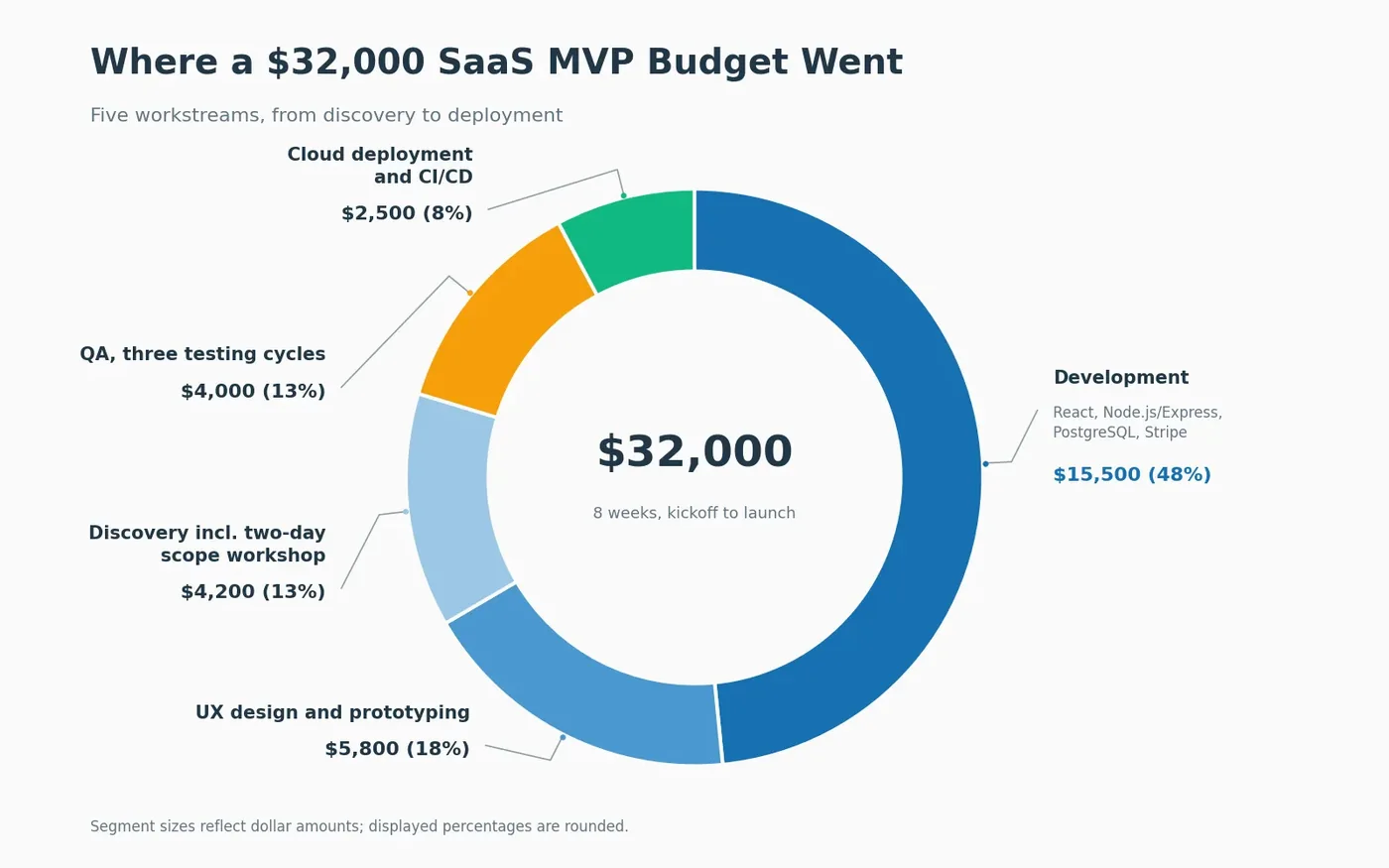
A SaaS startup building a project management MVP spent $32,000 in total: $4,200 on discovery, including a two-day scope workshop, $5,800 on UX design and prototyping, $15,500 on development covering a React frontend, Node.js and Express backend, PostgreSQL database, and Stripe integration, $4,000 on QA across three testing cycles, and $2,500 on cloud deployment with CI/CD setup. The project ran eight weeks from kickoff to launch.
Scenario 2: What scope discipline is actually worth.
A separate account covering more than 50 SaaS MVP builds compared three real outcomes at different budgets: a $22,000 build, a $41,000 build, and a $68,000 build for comparable products.
The $22,000 build came in cheapest because scope decisions were locked before development started. The $68,000 build ran over specifically because they weren’t.
The $41,000 build landed where it did because the founder was realistic about what “MVP” actually meant for their product.
Budget size alone didn’t predict the outcome. Scope discipline did.
Both examples are included to show how a real budget behaves in practice, not as a guaranteed cost for every project.
How Intigate Technologies Approaches SaaS MVP Development
Intigate Technologies works with startups and enterprises across India, UAE, Kuwait, and Qatar on SaaS, web, and software development projects, including work in Healthcare and mHealth, Fintech and Banking, E-commerce and Retail, and Marketing and AdTech.

Every engagement starts with a scoped discovery phase built around the same principle covered above: define the one assumption the MVP needs to validate, and hold the feature list to that assumption before writing a single scope document.
From there, the process moves through design, agile development sprints with fixed-length cycles, structured QA embedded into each sprint rather than saved for the end, and deployment with monitoring configured before launch, not added after an incident.
This sequencing exists specifically to avoid the scope-creep and missing-QA failure patterns covered in the sections above.
For teams evaluating build partners more broadly, our software development services page covers the full range of engagement models we support, from fixed-scope MVP builds to dedicated development teams.
Conclusion
There is no single correct answer to what a SaaS MVP costs.
There is a range, and where your project lands inside it is determined by feature complexity, team composition and location, and compliance needs, not by which vendor gives you the friendliest quote.
The founders who budget accurately are the ones who lock their must-have features first, price their team option against that scope, and build in a buffer for the hidden costs that rarely show up in an initial proposal.
The scope discipline shown in the examples above matters more than any single line item in this guide.
Whether you build in-house, hire freelancers, or work with an outsourcing partner, the framework covered here gives you a way to evaluate any vendor quote against it before you sign a contract.
Frequently Asked Questions
Frequently asked questions
How much does it cost to build a SaaS MVP?
Saas mvp development cost typically ranges from $8,000 to $150,000 or more in 2026. Simple MVPs with basic features cost $8,000 to $25,000. Complex, compliance-heavy, or AI-enabled MVPs can exceed $150,000, depending on team location and feature scope.
What is the difference between an MVP and a full SaaS product?
An MVP includes only the features needed to validate one core assumption with real users and is production-quality, not a prototype. A full SaaS product includes the complete feature set, premium tiers, and enterprise capabilities added after the MVP has validated market demand.
Is it cheaper to build a SaaS MVP in India?
Yes. Indian developer rates typically run $20 to $45 per hour compared to $100 to $250 per hour in the US, a 60 to 80 percent reduction for comparable expertise and quality, provided the outsourcing partner has strong process discipline
How long does it take to build a SaaS MVP?
Timelines generally run 4 to 6 weeks for a simple MVP, 6 to 10 weeks for a medium-complexity build, and 10 to 18 weeks for a complex, multi-tenant, or compliance-heavy MVP
Should I outsource my SaaS MVP or build it in-house?
It depends on your budget, timeline, and available technical skills. Outsourcing to an experienced partner in a lower-cost region can reduce spend by 60 to 80 percent versus in-house US hiring, without reducing quality, provided the partner has a disciplined scoping and QA process in place.
What’s the cheapest way to build a SaaS MVP?
A DIY build using a starter kit costs $1,000 to $10,000 if you can code and have a clear product vision. But the cheapest upfront isn’t always the cheapest overall. Underhiring on a build you can’t code yourself often leads to a costly rebuild later.
Published 28 July 2026 · Updated 5 October 2026