
MVP Prototype Cost in 2026: Pricing by Fidelity Level

MVP prototype cost typically falls between $0 and $25,000, and the fidelity level you choose decides where you land in that range.
Founders comparing this number against a full MVP development cost for startups estimate are often working from two different budgets without realizing it.
A prototype is a validation artifact. It tests design and user flow decisions before development begins.
An MVP is a working product built for real users, and ideally, real revenue. Confusing the two is the fastest way to either overspend early or underbudget the build that follows.
This article breaks down prototype cost by fidelity level, from a free paper sketch to a functional coded prototype, and shows what actually drives that cost up or down.
It is built for founders and product leads trying to control the cost to validate a startup idea before committing to a full build.

MVP Prototype vs. MVP: Why This Distinction Changes Your Budget
Prototype: an early, non-functional or semi-functional representation of a product, built to test design, usability, and user flow decisions before development begins.
MVP (Minimum Viable Product): a functional, market-facing version of a product that real users can use, and in most cases pay for, built to validate business assumptions rather than design assumptions.
The difference is not just semantic. Prototypes remain internal validation tools. They are typically shared with your team, investors, or a small testing group. MVPs are public and built for real end users.
This is why cost differs so much between the two. A prototype only needs to demonstrate an idea convincingly enough to test it.
An MVP needs backend infrastructure, integrations, quality assurance, and deployment. That added scope is why MVP development typically starts around $15,000 to $50,000 and can exceed $100,000 for complex builds (Gembah, 2025; SolveIt, 2026) — a range that holds up throughout this article and in the MVP-development guide linked below.

Set side by side, the prototype vs MVP cost gap looks like this:
| # | Prototype | MVP |
|---|---|---|
| Cost | $0 – $25,000 | $15,000 – $100,000+ |
| Timeline | Hours to 8 weeks | 2 to 6+ months |
| Purpose | Validate design and user flow | Validate market demand and business viability |
| Deliverable | Wireframe or clickable mockup | Working software with real functionality |
| Audience | Internal team, investors, test users | Real, paying or active end users |
MVP Prototype Cost by Fidelity Level (The Real Breakdown)
The average cost to build a prototype depends far more on fidelity level than on how ambitious the underlying idea is. Here is what each tier actually costs.
Sketch or paper prototype
A sketch or paper prototype costs nothing beyond your own time, effectively. This stage requires no specialized tools or outside help — pen, paper, or a basic digital whiteboard (FigJam, Miro) is genuinely sufficient.
It is sufficient for testing your own thinking or gathering informal feedback before committing to anything more formal.
Low-fidelity wireframe
A low-fidelity wireframe typically starts around $1,500 for a simple, clickable version built in a tool like Figma or Balsamiq.
This tier maps out screens and user flow without visual polish. It is enough to validate whether your core flow makes sense before investing in design.
High-fidelity clickable prototype
A high-fidelity clickable prototype has every screen designed and every flow clickable. It generally costs between $5,000 and $25,000, depending on the number of screens, the amount of user research, and the number of rounds of iteration needed.
This tier typically takes four to eight weeks to complete.
It is the right investment for investor demos or structured user testing, since it looks and feels like a real product without any working code behind it.
Functional or coded prototype
A functional or coded prototype sits in the gray area between an MVP and a full product. It includes working code, though usually not production-ready.
A no-code prototype at this tier typically starts around $10,000, while a fully custom, manually coded version starts closer to $25,000.
This tier is only worth the added cost if you specifically need to prove technical feasibility, not just design validation.
| Fidelity Tier | Cost | Timeline | Best For |
|---|---|---|---|
| Sketch or paper | $0 | Hours to 1 day | Personal clarity, informal feedback |
| Low-fidelity wireframe | $1,500 – $5,000 | 1 to 2 weeks | Early flow testing, internal alignment |
| High-fidelity clickable prototype | $5,000 – $25,000 | 4 to 8 weeks | Investor demos, structured user testing |
| Functional or coded prototype | $10,000 – $25,000+ | 6 to 10 weeks | Proving technical feasibility |

What Drives MVP Prototype Cost Up or Down
Number of screens and user flows
Every additional screen and user flow adds design and testing hours. A single-flow prototype, such as sign-up plus one core action, costs far less than a multi-flow prototype covering onboarding, a dashboard, and settings.
Design complexity
A template-based design using an existing component library costs less than a fully custom visual identity built from scratch. Custom illustration, animation, or brand-specific interaction design adds hours that show up directly in the invoice.
Research and testing scope
Prototypes that include structured user research, such as interviews or usability testing rounds, cost more than prototypes built purely from internal assumptions.
Discovery phases that bundle research, wireframes, and a clickable prototype together typically run $5,000 to $15,000. Regulated industries such as fintech, banking, and healthcare or mHealth often need extra compliance and data-handling research even at the prototype stage.
Budget additional research time for any prototype that will eventually touch financial or health data — compliance review at the prototype stage is cheaper than discovering a data-handling problem after development starts.
Team model and geography
Freelancers, agencies, and in-house teams price prototype work differently, and location affects hourly rates significantly.
Development teams based in India, for example, are frequently priced 35 to 55 percent lower than equivalent-quality US-based teams for the same scope of work.
If you are comparing vendors, our guide to top software development outsourcing companies breaks down how to evaluate teams on more than hourly rate alone.
No-code and AI-assisted tools
No-code and AI-assisted design tools are lowering prototype cost across the board.
No-code MVP prototypes now start around $10,000, compared to $25,000 or more for a fully manual build.
For teams weighing whether to build in-house or bring in outside help at this stage, our software development services page outlines how a scoped engagement typically works.
How prototype work actually gets billed
Fidelity-tier ranges assume a flat-quote model, but a meaningful share of the market bills differently.
Some studios price per unique screen rather than by tier; a common structure runs somewhere in the €150–€250 range per screen, with revisions bundled in.
Freelance marketplaces show the same fragmentation: narrow-scope clickable prototypes (a handful of screens, one flow) list anywhere from a few hundred to a few thousand dollars, well under the $1,500 floor this article uses for a “typical” low-fidelity wireframe.
If a quote you’ve received looks unusually low, ask whether it’s scoped per-screen rather than for the full flow; that’s usually the explanation, not a red flag.
How to Reduce MVP Prototype Cost Without Cutting Corners
Reducing prototype cost is less about cutting scope randomly and more about sequencing decisions correctly.

- Prioritize ruthlessly. Limit your prototype to one to three core user flows. Everything else can wait until after validation.
- Use existing design systems. Component libraries and pre-built UI kits cut design hours significantly compared to building a custom visual system from zero.
- Test the clickable prototype before writing code. Catching a flawed user flow at the prototype stage costs design hours. Catching it after development starts costs developer sprints, and often a rebuilt database schema.
- Know when to skip the prototype phase entirely. For very simple, low-risk internal tools where the scope is already well understood, moving straight into a lightweight build can be faster and cheaper than a formal prototyping phase.
A practical filter for step one, borrowed from lean product practice, asks three questions about any feature under consideration: can users succeed without it, can you fake it manually instead of building it, and does it actually test the risk you care about? Features that fail all three tests belong in a later version, not the prototype.
When to Move From Prototype to MVP
A prototype has done its job once it consistently answers the questions you built it to answer.
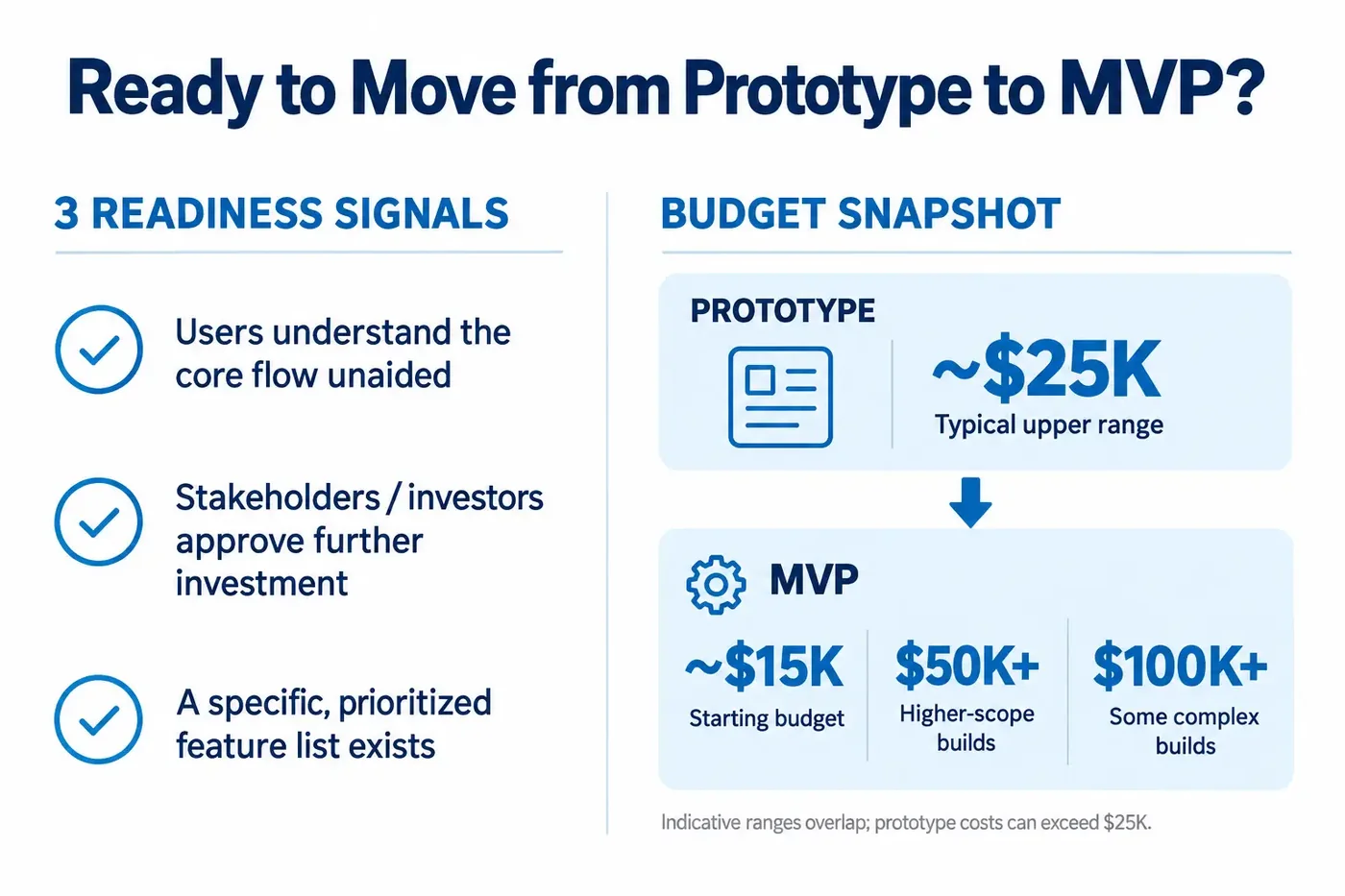
Signals that you are ready to move forward typically include target users understanding the core flow without explanation, stakeholders or investors approving further investment based on what they saw, and a specific, prioritized feature list rather than an open-ended wish list.
If your prototype is still generating conflicting feedback about basic flow or purpose, that is a sign to keep iterating in the prototype phase.
Once you move into MVP development, cost and scope shift substantially.
You are no longer paying for design and validation alone. You are paying for backend infrastructure, authentication, data storage, third-party integrations, quality assurance, and deployment.
That is why MVP budgets typically start around where prototype budgets end, near $15,000, and climb toward $50,000 or more depending on complexity — sometimes well past $100,000 for compliance-heavy or highly integrated builds.
For a full breakdown of that next stage, see our saas MVP development cost guide, which covers cost by feature set, team model, and industry.
Conclusion
MVP prototype cost depends almost entirely on fidelity level, not on how big or ambitious your product idea is.
A paper sketch costs nothing. A low-fidelity wireframe starts around $1,500.
A high-fidelity clickable prototype runs $5,000 to $25,000. A functional coded prototype pushes toward $25,000 and starts overlapping with MVP-level investment.
The right tier depends on what you are actually trying to validate: your own thinking, a design decision, or technical feasibility.
Choosing the lowest fidelity tier that still answers your specific question is the most reliable way to control MVP prototype cost without under-validating your idea.
Once your prototype has done that job, the cost conversation shifts to MVP development, where infrastructure, integrations, and real users enter the budget.
Frequently Asked Questions
Frequently asked questions
How much does a clickable prototype cost?
The cost of an MVP prototype at the clickable, high-fidelity stage typically falls between $5,000 and $25,000, depending on the number of screens, the amount of user research, and how many rounds of iteration are needed. Simpler clickable prototypes with fewer screens can start closer to $1,500.
Is a prototype cheaper than an MVP?
Yes. A prototype is a design and validation artifact, not working software, which keeps its cost well below an MVP. Prototypes typically range from $0 to $25,000, while MVP development starts around $15,000 and can exceed $100,000 depending on complexity.
Can I build an MVP prototype for free?
Yes, at the lowest fidelity tier. A paper sketch or basic digital wireframe costs nothing beyond your own time. It is sufficient for testing your own thinking or gathering informal feedback before investing in a designed, clickable version.
How long does it take to build an MVP prototype?
Prototype development typically takes one to eight weeks, depending on fidelity level. Low-fidelity wireframes can be finished in one to two weeks, while high-fidelity clickable prototypes generally take four to eight weeks.
Do I need a prototype before building an MVP?
Not always, but it is recommended for most new products. A prototype lets you test design and flow decisions while changes still cost design hours instead of developer time, which reduces the risk of expensive rework once MVP development begins.
Published 29 July 2026 · Updated 22 September 2026