
- Hiring a software development company requires evaluating technical expertise, Agile Scrum processes, security compliance, and delivery transparency before signing a contract.
- Companies using Jira, GitHub, and CI/CD workflows typically provide better project visibility and release management during software delivery.
- Software outsourcing partner selection should include code quality reviews, communication standards, and expectations for post-launch support to reduce operational risk.
- ISO 27001 and SOC 2 compliance indicators help businesses assess whether a software development company follows modern security and governance practices.
- A structured software development company evaluation checklist improves vendor comparison accuracy and reduces the likelihood of budget overruns or delivery delays.
A company invests six months and a significant budget into a software product, only to discover the vendor cannot scale the architecture or meet security requirements. The project stalls.
The code cannot be handed off cleanly. The business is left absorbing costs while starting the procurement process over from scratch.
This scenario is not rare; it is the predictable result of choosing a software vendor based on price or presentation rather than delivery capability.
Understanding what to look for when hiring a software development company is one of the highest-leverage decisions a technology or product leader makes.
The wrong vendor does not just delay a product; it compounds debt, erodes stakeholder confidence, and constrains future architecture choices.
What to look for when hiring a software development company includes technical expertise, delivery processes, communication standards, security compliance, and post-launch support that help businesses achieve predictable software outcomes.
This guide gives you the evaluation framework to do exactly that: assess vendors on technical merit, compare engagement models, identify red flags before they become budget crises, and shortlist a software development partner aligned with your business timeline and scalability requirements.
What to Look for in a Software Development Company
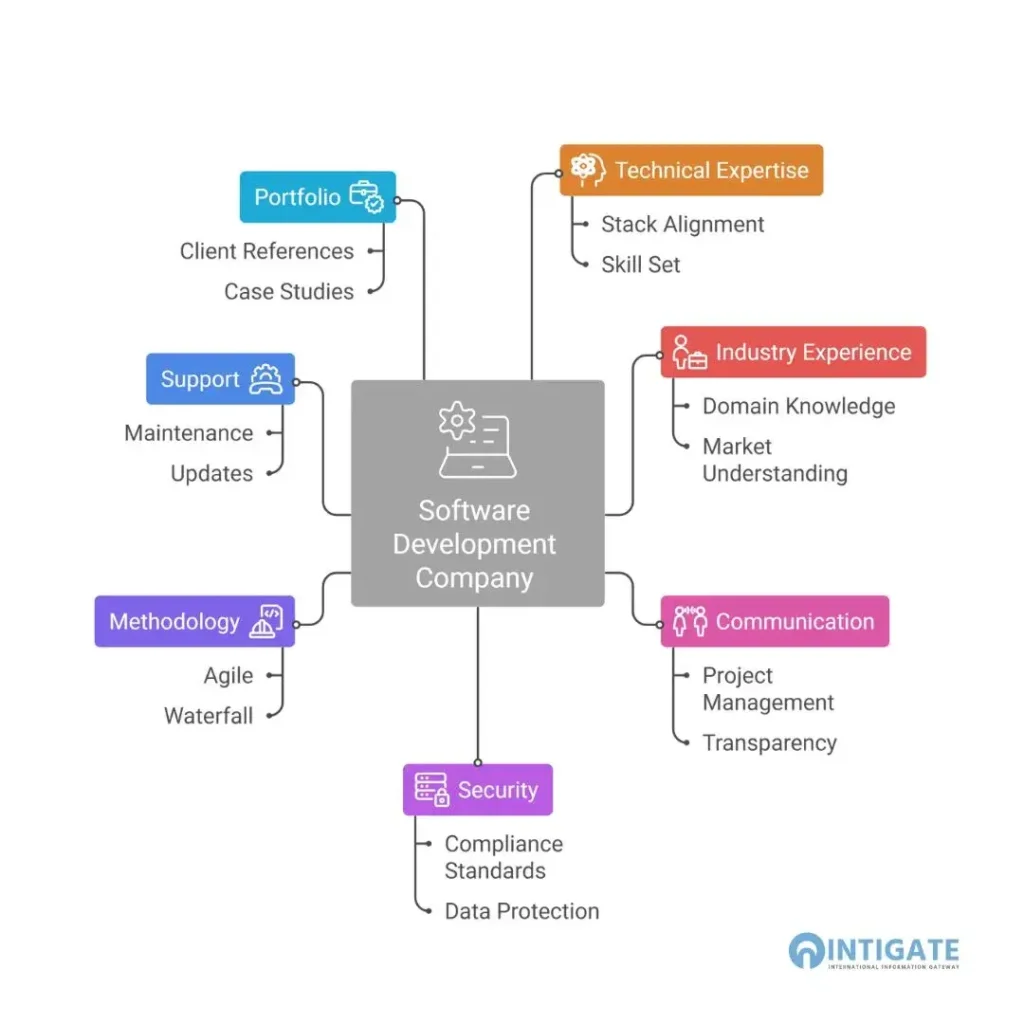
A reliable software development company demonstrates technical capability, transparent delivery processes, and measurable business alignment before any contract begins.
Most vendor comparisons start and end with portfolios and pricing. That is a shallow filter.
The companies that consistently deliver software on time and within scope share a different profile, one built around process maturity, communication architecture, and technical governance.
Here is the structured checklist that separates reliable vendors from those likely to cause problems at sprint 4.
Software development company evaluation checklist: A structured framework used to compare software vendors based on technical, operational, and business criteria before contract engagement.
1. Technical Expertise and Stack Alignment: Verify that the vendor has active, demonstrable experience with the technologies your project requires, not theoretical familiarity. Ask for GitHub repositories, technical documentation samples, or architecture diagrams from comparable projects.
2. Industry and Domain Experience: A vendor that has built healthcare platforms understands HIPAA constraints. A vendor that has delivered fintech products understands latency, transaction integrity, and regulatory audit trails. Domain experience is not optional for regulated industries or complex integrations.
3. Communication and Project Management Workflows: Evaluate whether the vendor uses Jira for sprint tracking, documents decisions, and maintains shared backlogs. Communication cadence, daily standups, sprint reviews, async update channels, and directly predict whether stakeholders receive adequate visibility.
4. Security and Compliance Standards Ask directly about ISO 27001 and SOC 2 certifications, data handling policies, and penetration testing practices. Vendors that cannot answer these questions immediately create organizational risk.
5. Development Methodology Agile Scrum or DevOps workflows enable iterative delivery and continuous improvement. Vendors without documented methodology tend to treat scope creep and timeline slippage as client problems rather than process failures.
6. Post-Launch Support and Maintenance Delivery does not end at go-live. Validate that the vendor offers defined SLAs, on-call support protocols, and clear handoff documentation if the relationship ends.
7. Portfolio Validation and Client References Reference checks with former clients reveal what vendor marketing materials cannot: how teams handle conflict, how they respond to delivery failure, and whether they communicate problems proactively or retrospectively.
Technical Capabilities and Architecture Expertise
The most consequential evaluation dimension is also the hardest to assess without technical knowledge. Ask prospective vendors to walk through the architecture of a recent comparable project — not the outcome, but the decisions: why they chose a microservices approach over a monolith, how they handled data consistency across services, what their approach to AWS or Azure infrastructure provisioning looks like, and how they manage scalability under load.
Vendors that deflect architecture conversations with marketing language are telling you something important.
Communication and Delivery Transparency
In practice, teams working on enterprise software projects typically discover communication gaps during sprint reviews rather than during initial sales discussions.
Evaluate the vendor’s communication stack before the contract: do they use shared Jira boards with client visibility?
Do they provide weekly status reports tied to sprint metrics? Do they escalate blockers within 24 hours or at the end of the sprint? These questions surface operational maturity faster than any portfolio review.
Security, Compliance, and Risk Management
Security evaluation is not a checkbox. Assess whether the vendor has documented data classification policies, access control frameworks, and incident response procedures.
ISO 27001 certification indicates a formalized information security management system.
SOC 2 Type II compliance demonstrates that security controls have been audited over time, not just designed.
For healthcare, fintech, or government clients, these are minimum entry requirements, not differentiators.
The Real Cost of Hiring a Software Development Company
The cost of hiring a software development company depends on project complexity, engagement model, team location, and long-term maintenance requirements.
Procurement teams frequently approach software vendor selection as a cost comparison exercise.
The lowest proposal wins. This approach reliably produces the most expensive outcomes, because it optimizes for contract value while ignoring total cost of ownership, which includes technical debt, rework, delayed delivery penalties, and documentation gaps that compound post-launch.
According to a Gartner survey on IT project outcomes, roughly half of all project failures — regardless of project size — stem from functionality issues and substantial delivery delays. For projects with budgets exceeding $350,000, budget overruns are the primary driver behind one in four failures. The failure rate of large IT projects with budgets over $1 million was found to be nearly 50% higher than for smaller projects, making vendor selection and scope governance critical before contract signature.
Common Software Pricing Models
| Model | Best For | Risk Profile |
| Fixed Price | Well-scoped, low-ambiguity projects | Scope changes create change-order friction |
| Time & Materials | Evolving requirements, Agile delivery | Budget can expand without milestone controls |
| Dedicated Team | Long-term product development | Requires strong internal product ownership |
| Milestone-Based | Phased deliverables, staged investment | Vendor incentivized to hit dates, not quality |
For most custom software development engagements, dedicated-team or milestone-based models with time-and-materials flexibility offer the best balance of predictability and adaptability.
Offshore vs nearshore vs local agencies represent a cost spectrum, not just a geography decision.
Offshore teams in Eastern Europe or Southeast Asia offer significant hourly rate advantages, typically 40–70% lower than US-based agencies.
The tradeoff includes timezone coordination overhead, cultural communication differences, and variable IP protection enforcement.
Nearshore teams in Latin America reduce timezone friction while maintaining cost efficiency.
Local agencies offer the highest collaboration proximity at the highest hourly cost.
Hidden Costs Businesses Often Miss
The line-item invoice rarely reflects the true cost of a software engagement. Factor in:
- Technical debt remediation: poorly written code that requires refactoring six months post-launch
- Documentation gaps: undocumented architecture that prevents knowledge transfer or team scaling
- Change request overhead: scope additions priced at a premium by fixed-fee vendors
- Infrastructure cost surprises: AWS or Azure resource estimates that did not account for production load
- Support gaps: absence of SLAs that force expensive emergency retainer agreements post-launch
- Kubernetes and container management: vendors without DevOps maturity often leave businesses managing infrastructure they did not budget for
The cheapest vendor is rarely the lowest total-cost vendor.
Compare pricing models, delivery risks, and long-term maintenance considerations before committing to a software development partner.
Estimate Project ROI with Experts →Software Development Outsourcing vs In-House Teams
Software outsourcing reduces hiring overhead and accelerates delivery, while in-house development provides deeper organizational control and institutional knowledge.
Neither model is categorically superior. The right decision depends on project timeline, internal technical capacity, budget structure, and the strategic importance of the software being built.
| Factor | Outsourcing | In-House |
| Upfront Cost | Lower | Higher (salaries, benefits, tooling) |
| Speed to Start | Faster (weeks) | Slower (months) |
| Talent Access | Broader specialization | Limited to local market |
| Scalability | Flexible (add/remove team members) | Constrained by hiring cycles |
| Limited to the local market | Lower (knowledge risk) | Higher (institutional knowledge) |
| DevOps / Agile Maturity | Vendor-dependent | Fully internal control |
| IP Protection | Requires contractual diligence | Inherent |
When Outsourcing Makes Strategic Sense
Outsourcing is the stronger choice when speed to market is a competitive variable, when the required technical specialization does not justify full-time headcount, or when the project is bounded and time-limited.
Startups building MVPs, enterprises launching adjacent digital products, and product teams needing Agile Scrum velocity without full team expansion are natural outsourcing candidates.
GitHub-based collaboration and CI/CD-integrated delivery pipelines make distributed team management increasingly viable.
When In-House Development Is Better
In-house development is worth the investment when the software being built is the product, when it represents core IP, requires deep domain immersion, or will be extended continuously over the years.
Customer-facing platforms, proprietary algorithms, and regulated data systems benefit from teams embedded in an organizational context rather than working at arm’s length.
How to Evaluate Software Development, Vendors
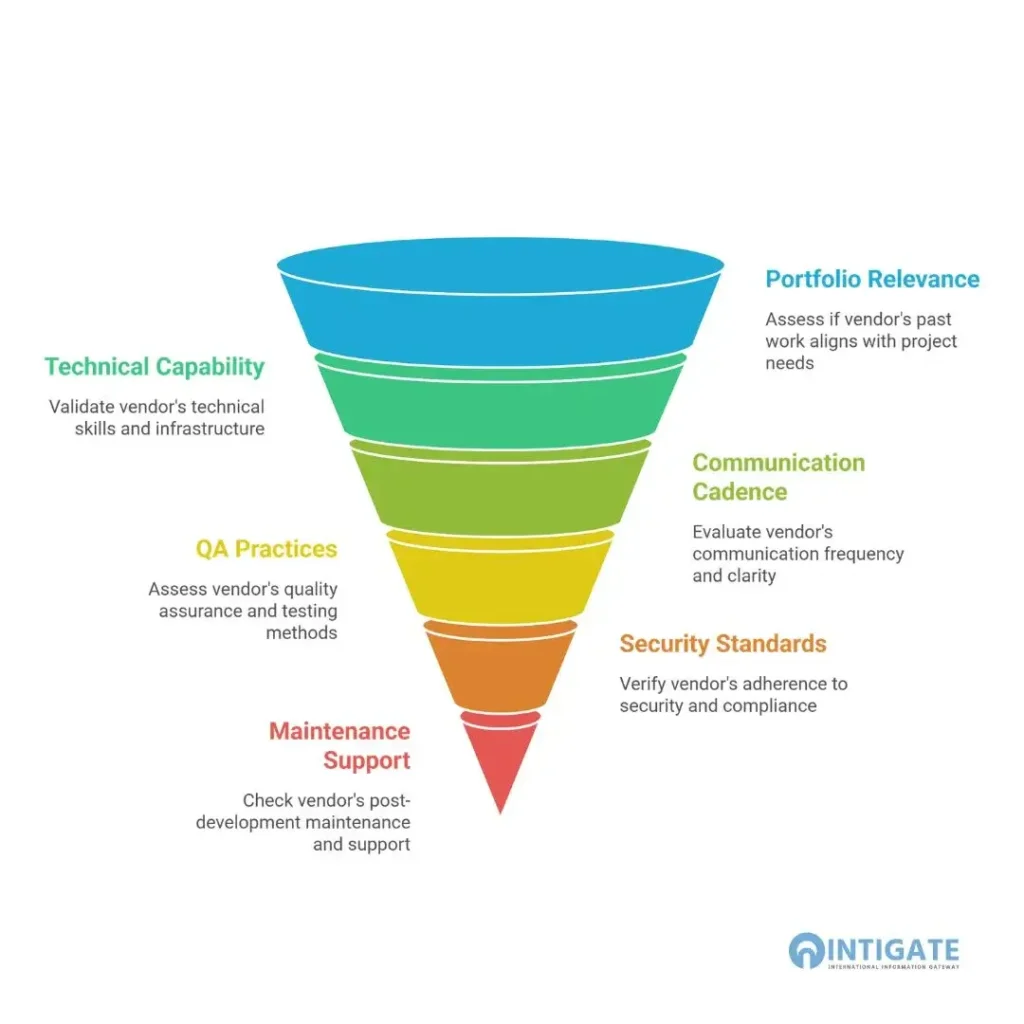
Evaluating a software development vendor requires verifying technical delivery capability, operational maturity, and business alignment before project kickoff.
Technical due diligence: The process of verifying whether a software vendor can reliably deliver scalable, secure, and maintainable software before a commercial engagement begins.
Research from McKinsey confirms the stakes:70% of large-scale transformation projects fail to meet their objectives, with poor execution, misaligned vendor partnerships, and inadequate organizational readiness cited as the primary causes. A separate McKinsey analysis of 600+ firms that underwent digital transformations found only 20% achieved more than three-quarters of their projected revenue gains — and only 17% captured more than three-quarters of expected cost savings.
Step 1: Review Portfolio Relevance. Assess whether prior projects share meaningful characteristics with yours, industry, complexity, integration requirements, or regulatory environment. A portfolio filled with consumer mobile apps does not validate enterprise B2B capability.
Step 2: Validate Technical Architecture Capability. Request architecture diagrams or technical write-ups from prior projects. Evaluate whether the vendor makes deliberate, defensible architectural decisions or defaults to familiar patterns regardless of fit.
Step 3: Assess Communication Cadence Map the vendor’s standard communication framework: sprint frequency, reporting format, escalation path, and client portal access. Misaligned communication expectations cause more project failures than technical deficiencies.
Step 4: Evaluate QA and Testing Practices A vendor without documented QA workflows, automated testing coverage standards, and regression testing protocols is delivering software risk, not software.
Step 5: Verify Security and Compliance Standards Confirm ISO 27001 certification status, SOC 2 audit history, and specific CI/CD security controls. For cloud-native development, evaluate whether the vendor applies security scanning at the pipeline level, not just at deployment.
Step 6: Check Maintenance and Support Model Understand what happens post-launch: who responds to production incidents, what the SLA structure looks like, and whether ongoing support is included, retainer-priced, or billed at standard hourly rates.
Questions to Ask During Vendor Interviews
- “Walk me through how you handled a project that was falling behind schedule.”
- “What does your sprint review process look like for a client stakeholder who is not technical?”
- “How do you manage scope change requests under a fixed-price model?”
- “What is your process when a security vulnerability is discovered post-deployment?”
- “Can you provide two client references from projects with similar complexity to ours?”
How to Verify Technical Claims
Claims made during sales conversations require independent validation.
Request access to a sample Jira project board. Ask for a code sample or open-source contribution.
Conduct a 30-minute technical interview with the lead architect who would own your project — not the solutions engineer who runs the sales conversation.
Vendors with genuine delivery capability welcome technical scrutiny. Vendors without it deflect it.
Red Flags to Avoid When Choosing a Software Development Company
Several warning signs can indicate that a software development company may struggle with delivery quality, transparency, or long-term scalability.
Identifying red flags before contract signature is significantly less expensive than identifying them during delivery. These signals are not edge cases; they appear consistently in post-mortem analyses of failed software engagements.
Technical Red Flags
Unrealistically low pricing: Proposals priced 40–60% below market for comparable scope are not a bargain. They reflect either scope misunderstanding, undisclosed subcontracting, or planned change-order inflation post-contract.
No documented development process: A vendor that cannot produce a written description of how it runs sprints, manages code reviews, or deploys to production is improvising rather than executing.
No QA or testing transparency: Absence of defined testing coverage, automated regression suites, or QA sign-off criteria means quality is aspirational rather than measured.
No security certifications: Vendors without SOC 2, ISO 27001, or OWASP-aligned security practices represent regulatory and reputational risk, particularly for any application handling user data.
Operational and Communication Red Flags
Weak communication cadence: If status updates require prompting rather than arriving on schedule, this pattern will persist and worsen under delivery pressure.
Vague post-launch support: “We’ll be available after launch” is not an SLA. The absence of a defined support and maintenance model signals that the vendor’s relationship interest ends at delivery.
No client references provided: Vendors with strong delivery track records provide references readily. Resistance or delay in providing references warrants significant skepticism.
Jira board access denied: Project management transparency is table stakes. Vendors who resist shared tooling access are managing your information exposure, not your project.
What to Expect During Software Development Implementation
A structured software implementation process improves delivery predictability and reduces scope, communication, and deployment risks.
The Standish Group’s CHAOS 2020 report, based on analysis of 50,000 projects globally, found that 66% of technology projects end in partial or total failure. Large projects, those most resembling enterprise custom software engagements, succeed less than 10% of the time. The report consistently identifies clear scope definition, executive sponsorship, and iterative delivery as the three strongest predictors of on-time, on-budget outcomes.
Understanding the implementation lifecycle helps business leaders set realistic expectations, define stakeholder responsibilities, and recognize early indicators of delivery risk.
Typical Delivery Timeline
Discovery Phase (Weeks 1–3): Requirements gathering, technical architecture definition, and project scope documentation. This phase produces the technical specification that governs all subsequent deliveries. Skipping or compressing discovery is the single most reliable predictor of scope disputes.
Sprint Planning and Design (Weeks 3–5): Backlog construction, UI/UX prototyping, and sprint roadmap creation. Agile Scrum teams using Jira establish sprint velocity benchmarks during this phase that govern realistic timeline projections.
Development Cycles (Ongoing, Sprint-Based): Active feature development executed in two-week sprints with defined acceptance criteria. Each sprint concludes with a client-facing review and retrospective. Docker containerization and CI/CD pipelines enable automated testing and deployment within each cycle.
QA and Testing (Parallel and End-of-Phase): Testing runs parallel to development — not as a terminal phase. Automated regression suites catch regressions early. UAT (user acceptance testing) occurs before each major deployment.
Deployment and Go-Live: Staged deployment to production with rollback procedures, infrastructure validation, and performance testing under anticipated load conditions.
Post-Launch Support: Monitoring, bug resolution, and performance optimization under the agreed SLA framework.
Success Metrics to Track
- Sprint velocity consistency (stability indicates delivery predictability)
- Defect density per sprint (high early defect rates signal code quality issues)
- Change request volume (disproportionate change requests often indicate scope definition failure)
- Mean time to resolution on production incidents
- Client satisfaction with the sprint review feedback
ROI and Business Value of Hiring the Right Software Partner
The right software development company improves operational efficiency, accelerates digital delivery, and reduces long-term technical debt.
Software is not a cost center; it is an operational and competitive asset. The business case for rigorous vendor selection is not just risk avoidance. It is value acceleration.
According to Deloitte’s Measuring Value from Digital Transformation research, organizations that use a holistic, multi-dimensional approach to measuring digital investment outcomes are 20% more likely to attribute medium-to-high enterprise value to their technology initiatives. A separate Deloitte AI and tech investment ROI study found that over 95% of respondents said digital initiatives have lifted market capitalization or return on equity, with firms embedding structured delivery practices into their software investments reporting the strongest results.
Faster product launches: Vendors with mature Agile Scrum delivery consistently reach the market faster than those improvising process. Each sprint is a predictable unit of delivery, not a variable.
Reduced maintenance costs: Well-architected software built on AWS or Azure with documented infrastructure reduces operational overhead. Technical debt from low-quality initial delivery compounds maintenance costs annually.
Better scalability: PostgreSQL database design, microservices architecture, and DevOps-managed infrastructure built for scale, avoiding the costly rewrites that accompany rapid growth when the architecture was not designed for it.
Improved customer experience: Quality code produces fewer bugs, faster load times, and more reliable features, all of which directly affect user retention and brand perception.
Operational automation: Custom software delivers efficiency gains that SaaS tools cannot replicate: workflows built to your specific processes, integrations with your existing systems, and automation logic that eliminates manual steps.
Competitive differentiation: Proprietary software is a competitive moat. Businesses that invest in quality development build capabilities that their competitors cannot simply purchase.
Short-Term vs Long-Term ROI
Short-term ROI is measured in delivery metrics: on-time launch, within-budget delivery, and minimal post-launch defects.
Long-term ROI compounds over the product’s operational lifetime, reduced maintenance spend, lower rework costs, a scalable architecture that accommodates growth without full rewrites, and institutional knowledge preserved in documentation rather than locked in a vendor’s head.
Measuring Software Project Success
Define success metrics before development begins:
- Feature delivery rate vs committed sprint roadmap
- Post-launch defect resolution time
- Infrastructure cost vs projection
- User adoption rate vs product goal
- Time to first meaningful product iteration post-launch
Turn evaluation insights into a clear vendor selection strategy aligned with business goals, timelines, and scalability requirements.
Book a Technical Consultation →Conclusion
Knowing what to look for when hiring a software development company begins with understanding that vendor selection is a risk management decision, not a price negotiation.
The frameworks that consistently produce successful outcomes combine technical evaluation, architecture capability, security compliance, QA maturity, with operational assessment: communication standards, delivery transparency, and post-launch accountability.
Pricing models, outsourcing vs. in-house comparisons, and implementation expectations all inform the decision, but only when evaluated in the context of your specific project complexity and business timeline.
Over the next 12–24 months, AI-assisted development, DevOps automation, and cloud-native architecture will increasingly separate high-performing software vendors from commodity providers.
Vendors integrating AI code generation into CI/CD pipelines, building on managed AWS and Azure services, and investing in automated testing infrastructure will deliver faster and at a lower marginal cost.
The evaluation criteria in this guide reflect today’s standards; expect the compliance and security dimensions, particularly around data governance and AI model usage, to become more stringent, not less.
Create a structured vendor shortlist based on the criteria in this guide. Begin technical due diligence with the top three candidates before making a final selection.
Request architecture discussions, client references, and documented process frameworks, not just polished proposals. The vendors worth working with will welcome the rigor.
Frequently Asked Questions
What should you check before hiring a software development company?
Before hiring a software development company, verify technical expertise in your required stack, assess communication and project management processes, review security standards including ISO 27001 and SOC 2 alignment, and validate portfolio relevance through reference checks. The most important pre-contract checks combine technical due diligence, architecture capability, QA processes, CI/CD maturity, with operational evaluation: sprint cadence, client visibility tools like Jira, and defined post-launch support. Skipping any of these dimensions increases delivery risk proportionally.
How much does it cost to hire a software development company?
The cost of hiring a software development company varies based on engagement model, project complexity, team location, and ongoing maintenance requirements. Fixed-price engagements for well-scoped projects can range from tens of thousands to hundreds of thousands of dollars. Dedicated team models are priced by monthly team composition. Offshore teams in Eastern Europe or Southeast Asia typically cost 40–70% less per hour than US-based agencies. Budget for hidden costs, including technical debt remediation, change requests, infrastructure on AWS or Azure, and post-launch support — which frequently exceed the original contract value when vendor selection was cost-driven rather than capability-driven.
What is the difference between outsourcing software development and hiring in-house developers?
Outsourcing software development provides faster access to specialized talent, lower upfront cost, and delivery scalability without long-term headcount commitments. In-house development provides organizational control, institutional knowledge accumulation, and deeper alignment with business context, at a higher cost and slower ramp time. Outsourcing is stronger for bounded projects, MVPs, and teams needing Agile Scrum velocity quickly. In-house is stronger for core-product development where the software is the business and long-term knowledge retention is a strategic priority.
How do you evaluate a software development company?
Evaluating a software development company requires a structured technical due diligence process: review portfolio relevance, validate architecture decision-making capability, assess QA and testing documentation, verify security certifications like SOC 2 and ISO 27001, evaluate communication cadence against your operational needs, and conduct reference checks with former clients on comparable projects. Run a brief technical interview with the architect who would own your project — not just the sales team – and request access to sample Jira boards or documentation from a prior engagement. Vendors with genuine delivery track records welcome this scrutiny.
Is hiring a software development company right for startups?
Hiring a software development company is often the right choice for startups because it accelerates MVP development without the time and capital overhead of building an in-house engineering team from scratch. Access to specialized technical talent, mobile, cloud, AI, and DevOps – enables startups to ship faster and iterate based on real market feedback. Budget efficiency is higher in the early stages when you pay for delivered output rather than full-time salaries, benefits, and recruiting costs. The key consideration is selecting a vendor with genuine startup project experience: defined MVP scoping frameworks, iterative Agile delivery, and the flexibility to adjust scope as product-market fit is clarified.