

- How long does it take to build a custom app depends on complexity — basic apps take 2–4 months, mid-complexity apps 4–7 months, and enterprise-grade apps 7–12+ months.
- Features such as real-time chat, payment gateways, and third-party API integrations each add meaningful development time to any project.
- Choosing cross-platform frameworks like Flutter or React Native can reduce mobile app development timelines by eliminating the need for separate iOS and Android codebases.
- Adopting an MVP (Minimum Viable Product) approach is the most reliable way to launch faster while still validating your core product concept.
- Scope creep, poor requirement documentation, and infrequent communication between stakeholders and developers are the leading causes of delayed app launches.
How long does it take to build a custom app? It is one of the first questions every founder, CTO, and product manager asks, and the honest answer is: it depends, but rarely as little as you hope and rarely as long as you fear.
For most businesses, a custom app development timeline runs anywhere from 2 to 9 months, with highly complex platforms extending well beyond that.
Getting the timeline wrong has direct business consequences.
Underestimating scope leads to rushed launches, poor code quality, and costly post-launch fixes.
Overestimating leads to lost market opportunities. What your organization needs is a structured, realistic framework, one grounded in how app development actually works, not how agencies pitch it.
This guide breaks down every stage of a custom app development timeline, the specific factors that compress or extend it, and the decisions your team can make today to ship faster without sacrificing quality.
Get a Timeline Built Around Your Specific App. Intigate Technologies provides free, no-obligation scoping consultations — so you receive a development estimate grounded in your actual requirements, not industry averages.
Book Your Free Consultation →Quick Answer – How long does it take to build a custom app
The custom app development timeline varies significantly depending on the product’s scope and scale. Here is a reliable baseline:
| App Type | Estimated Timeline | Example Use Cases |
| Basic App | 2-4 months | Calculators, booking forms, simple utilities |
| Medium Complexity | 4-7 months | E-commerce apps, appointment platforms, internal tools |
| Complex App | 7-12+ months | Fintech platforms, social networks, and healthcare apps |
These ranges assume a competent, dedicated development team and reasonably stable requirements. Each phase from discovery through deployment is documented below with its own time allocation.
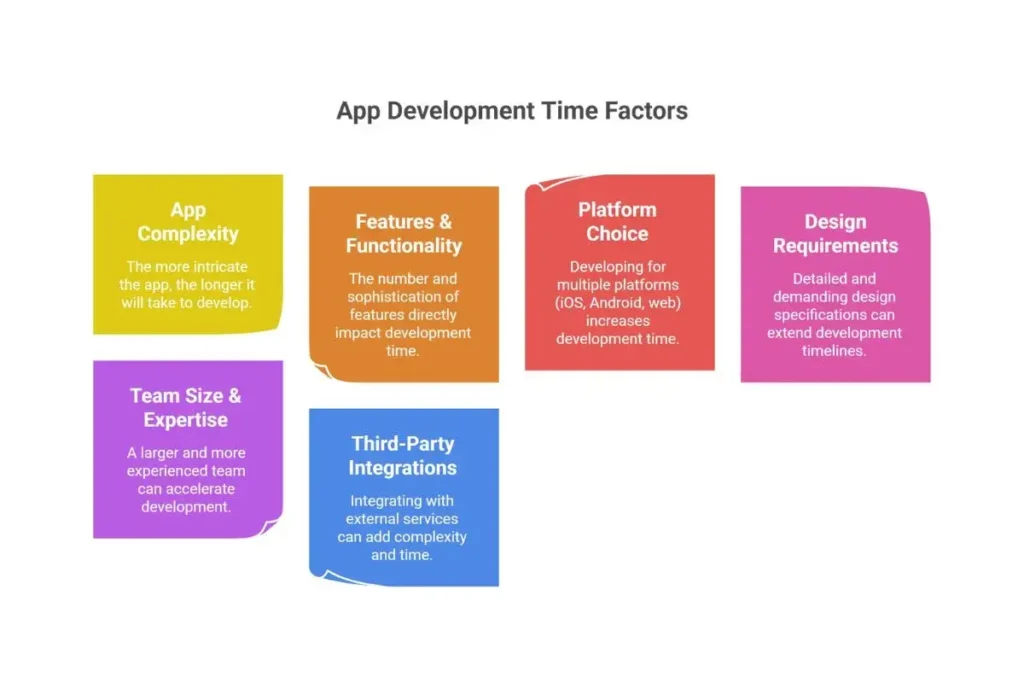
Key Factors That Affect App Development Time
No two app projects are identical. Understanding which variables drive your timeline gives your organization a meaningful planning advantage.
App Complexity
App complexity is the single greatest predictor of development duration.
A straightforward utility app, such as a unit converter or event countdown timer, requires a fraction of the architecture, logic, and testing that an Uber-style on-demand marketplace demands.
Basic apps typically involve a limited number of screens, minimal backend logic, and simple data storage.
Complex apps require distributed systems, real-time data processing, role-based access controls, and robust failure handling across multiple user types.
Features & Functionality
Each feature your app includes adds time to the development estimate. Some of the most time-intensive features include:
- User authentication and onboarding (social logins, multi-factor authentication)
- Payment gateway integration (Stripe, Razorpay, PayPal)
- Real-time messaging or notifications (WebSockets, push notifications)
- GPS/location services (mapping, geofencing, route calculation)
- Media handling (image/video upload, compression, streaming)
Prioritizing features for a first release rather than building everything at once is the most reliable way to manage scope and timeline.
Platform Choice
Building for iOS alone, Android alone, or both natively roughly doubles development effort compared to a single-platform build.
Cross-platform frameworks such as Flutter and React Native allow a single codebase to target both platforms simultaneously, compressing timelines by an estimated 30–40% for most standard apps.
Web app development introduces its own set of considerations around browser compatibility, responsive design, and performance optimization.
Design Requirements
Custom UI/UX design built from scratch based on brand guidelines and user research typically adds 2–4 weeks to a project compared to using pre-built component libraries or design templates.
For consumer-facing products where experience is a differentiator, that investment is often worthwhile. For internal tools or MVPs, template-based design accelerates delivery without meaningful compromise.
Development Team Size & Expertise
A solo freelancer building your app will work sequentially; a structured agency team — comprising a project manager, designer, frontend developer, backend developer, and QA engineer works in parallel.
Team composition can cut calendar time nearly in half for mid-to-large projects, even if total development hours remain similar.
For detailed guidance on structuring your engagement and budget, see the App development cost guide.
Third-Party Integrations
Connecting your app to external systems such as CRMs like Salesforce, shipping APIs, ERP platforms, or government data sources introduces dependencies outside your team’s control.
API documentation quality, rate limits, sandbox availability, and third-party support responsiveness all affect how quickly integrations can be completed and tested.
App Development Timeline Breakdown (Step-by-Step)
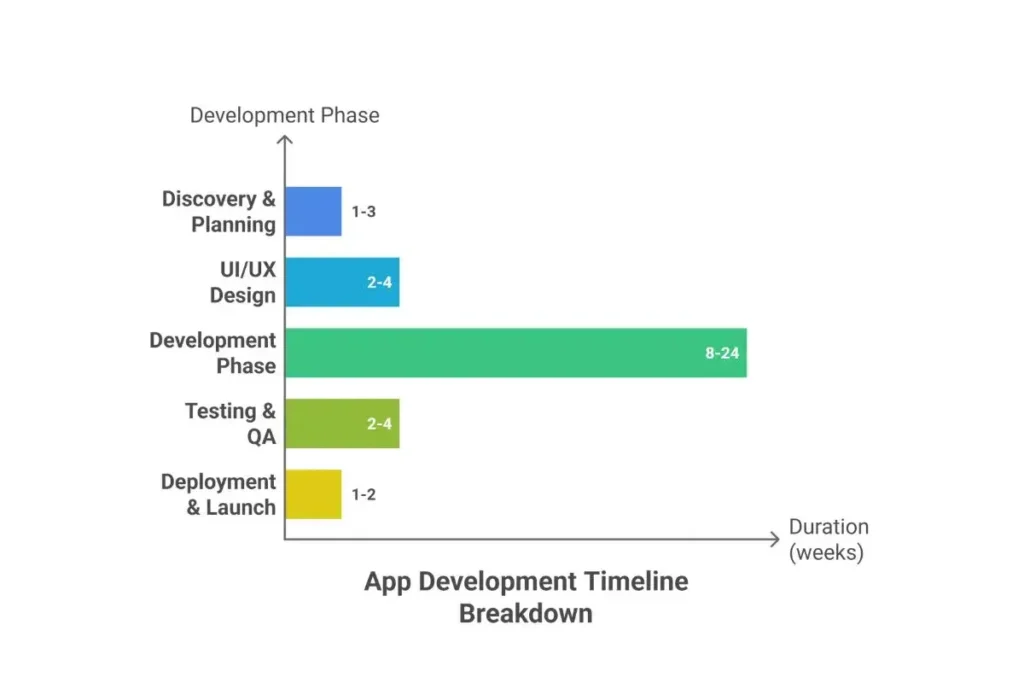
Every custom app, regardless of size, moves through five core phases. Here is what each phase involves and how long it realistically takes.
1. Discovery & Planning (1–3 Weeks)
The discovery phase is where requirements are defined, business goals are aligned with technical feasibility, and the project scope is formally documented.
Activities include stakeholder interviews, competitor analysis, technical architecture planning, and creation of a project roadmap.
Skipping or rushing discovery is the primary cause of expensive mid-project pivots. Every hour invested here saves multiple hours during development.
2. UI/UX Design (2–4 Weeks)
Design begins with low-fidelity wireframes, structural blueprints of each screen, and progresses to high-fidelity interactive prototypes that simulate the final product experience.
User testing at the prototype stage identifies usability issues before a single line of production code is written.
The output of this phase is a complete design specification that the development team builds against, eliminating ambiguity during execution.
3. Development Phase (2–6 Months)
This is the longest phase and involves building the frontend (what users see and interact with) and backend (server logic, databases, APIs, and integrations) in parallel.
Development is typically structured in 2-week sprints under an Agile methodology, with working software demonstrated at the end of each cycle.
Iteration and feedback during this phase are normal — the goal is not to freeze requirements but to adapt intelligently as the product takes shape.
4. Testing & QA (2–4 Weeks)
Quality assurance encompasses functional testing, performance testing, security audits, and device/browser compatibility testing. Every defect caught in QA is exponentially cheaper to fix than one discovered post-launch.
For regulated industries such as fintech or healthtech, compliance validation and penetration testing add additional time to this phase.
5. Deployment & Launch (1–2 Weeks)
The final phase covers App Store and Google Play submission (each with its own review timeline), production environment configuration, monitoring setup, and go-live support.
Apple’s App Store review process typically takes 1–3 business days; Google Play is generally faster.
Post-launch, plan for a hypercare period of 2–4 weeks during which your team monitors performance and addresses any critical issues that emerge in production.
Know Your Costs Before You Commit Development timelines and costs are directly linked. The App development cost guide from Intigate Technologies breaks down realistic budgets by app type, team size, and region.
Read the Cost Guide →How to Speed Up App Development (Without Compromising Quality)
Faster delivery does not require cutting corners — it requires better decisions earlier in the process.
- Start with an MVP. Build only the features that validate your core value proposition. An MVP disciplines your team to launch something real rather than waiting for something perfect. For guidance on scoping your first release, see the MVP development guide.
- Choose cross-platform frameworks. Flutter and React Native allow a single engineering team to target iOS and Android simultaneously, reducing both development time and long-term maintenance burden.
- Hire an experienced development partner. Senior engineers make fewer architectural mistakes, debug faster, and require less oversight. The productivity difference between junior and senior teams compounds across a multi-month engagement.
- Document requirements before development begins. Vague briefs produce misaligned output. A detailed Product Requirements Document (PRD) with defined acceptance criteria for each feature eliminates the most common source of rework.
- Use Agile methodology. Iterative, sprint-based development surfaces problems early and keeps stakeholders informed, reducing the risk of large-scale course corrections late in the project.
Common Mistakes That Delay App Development
Understanding what slows projects down is as valuable as knowing how to accelerate them.
Scope creep is the most frequently cited cause of app launch delays. When new features are added mid-development without adjusting the timeline or budget, the entire project plan becomes unreliable. Every addition should trigger a formal change request and impact assessment.
Poor upfront planning forces developers to make architectural assumptions that may prove incorrect later, requiring significant rework. Requirements gathering is not a bureaucratic exercise; it is technical risk mitigation.
Frequent design changes during development are costly. Modifying UI components that have already been built and integrated is far more disruptive than refining wireframes before development begins.
Lack of stakeholder communication creates gaps between what the client expects and what the team is building. Weekly sprint reviews and a shared project management tool (Jira, Linear, Notion) are minimum requirements for a well-run project.
Custom App vs Ready-Made Solution – Timeline Comparison
Organizations frequently weigh custom development against adopting an existing SaaS platform. The right choice depends on your growth trajectory, differentiation requirements, and budget constraints.
| Dimension | Custom App | SaaS / Template Solution |
| Time to Launch | 2–12 months | 1–8 weeks |
| Scalability | Fully configurable | Limited by platform |
| Ownership | You own the codebase | Vendor-dependent |
| Customization | Unlimited | Restricted to platform features |
| Long-Term Cost | Higher upfront, lower ongoing | Lower upfront, recurring license fees |
| Competitive Advantage | High — purpose-built for your use case | Low — competitors use the same tool |
For organizations in competitive markets such as fintech, healthtech, and retail, where the product experience itself is the differentiator, custom development typically delivers superior long-term ROI despite the longer initial timeline.
Also factor in the ongoing software maintenance cost when comparing the two approaches.
How to Estimate Your App Development Timeline
Use this checklist before engaging any development partner. Completing it honestly will produce a significantly more accurate estimate.
- Define your feature list. Write out every screen and user action your app must support. Separate “must-have” from “nice-to-have” features.
- Choose your target platform(s). iOS, Android, web, or a combination, each has cost and timeline implications.
- Establish your budget range. Timeline and budget are directly linked. A constrained budget limits team size, which extends the calendar.
- Decide on your team model. Freelancer, boutique agency, or large dev shop, each offers different speed, risk, and cost profiles.
- Identify third-party dependencies early. Map out every external API, payment provider, or data source your app requires.
- Set a realistic launch target. Work backward from your go-to-market date to understand whether your timeline is feasible or whether your MVP scope needs to be reduced.
Why Trust Matters in App Development
Selecting a development partner is a significant business decision.
The team at Intigate Technologies has delivered custom software across fintech, healthtech, and retail verticals, working with founders, product managers, and enterprise procurement teams who need timelines they can plan around.
What distinguishes a trustworthy development partner is not a promise of speed; it is transparency about what is feasible, documented milestones, and a track record of delivering working software that matches the original scope.
Ask any prospective partner for: a portfolio of live apps in your industry, client references willing to discuss project timelines, and a clearly structured onboarding process that begins with discovery before quoting.
Get a Custom Development Estimate in 48 Hours. Tell the team at Intigate Technologies what you’re building. They’ll scope your project, outline a realistic timeline, and identify the fastest path to your first release.
Request Your Free Estimate →Frequently Asked Questions (FAQs)
How long does it take to build an app from scratch?
Building an app from scratch typically takes between 2 and 12 months, depending on complexity. A basic single-platform app with core features can be delivered in 2–4 months. A full-featured, multi-platform application with complex integrations generally requires 7–12 months or more with a structured development team.
Can you build a custom app in 1 month?
A functional app can be delivered in one month only under very specific conditions: a clearly defined MVP scope, a pre-assembled team, no custom design requirements, and minimal integrations. For most real-world business applications, one month produces a proof of concept, not a production-ready product.
What is the fastest way to build a custom app?
The fastest path combines three elements: an MVP scope (build only what you must have at launch), a cross-platform framework such as Flutter or React Native, and an experienced development team with a defined Agile process. Comprehensive requirement documentation before development begins eliminates the rework that most often extends timelines.
Does app complexity significantly affect development time?
Yes, complexity is the primary driver of development time. A simple utility app may be completed in 6–8 weeks. An enterprise-grade platform with real-time features, third-party integrations, and regulatory compliance requirements can take 12–18 months. The relationship between complexity and timeline is not linear; architectural decisions made early in a complex project create compounding downstream effects.
How does team size affect the app development timeline?
A larger, well-structured team enables parallel workstreams, and design, frontend, and backend development can occur simultaneously, compressing calendar time without increasing total development hours. A solo developer working sequentially on the same scope will take significantly longer. For most business apps, a minimum team of 3–5 people is required to maintain meaningful development velocity.
Conclusion
The custom app development timeline is not a fixed number; it is a function of your requirements, your team, and the decisions you make before the first line of code is written.
Basic apps take 2–4 months; medium-complexity platforms 4–7 months; enterprise-grade products 7–12 months or more.
What separates on-time launches from delayed ones is rarely technical talent; it is process discipline, requirement clarity, and a realistic scope agreed upon before development begins.
Organizations that invest in thorough discovery and protect that scope throughout development consistently deliver better products, faster.
If your organization is planning a custom app, the most valuable action you can take right now is to define what you need to launch, not everything you want to build. That distinction is where realistic timelines are made.
Sources & References
The following verified, authority-domain sources informed the market context presented in this article.
- Grand View Research (2024): Application Development Software Market Size Report, 2030. The global application development software market was valued at $257.94 billion in 2024 and is forecast to grow to $862.67 billion by 2030, at a CAGR of 22.8%. → https://www.grandviewresearch.com/industry-analysis/application-development-software-market-report
- Statista (2025): Application Development Software – Worldwide Market Forecast. The worldwide application development software market is projected to generate $195.77 billion in revenue in 2025 and reach $250.91 billion by 2030, at a CAGR of 5.09%. → https://www.statista.com/outlook/tmo/software/application-development-software/worldwide
