
- Custom healthcare software development services enable medical organizations to eliminate operational inefficiencies and improve patient care delivery.
- Building secure, compliant digital health solutions requires strict adherence to mandatory regulations like HIPAA and GDPR.
- Investing in bespoke software ensures seamless interoperability with existing legacy systems, preventing data silos.
- Partnering with a specialized vendor guarantees that your platform is built to scale without sacrificing intellectual property ownership.
Custom Healthcare Software Development Services: How to Build Secure, Compliant, and Scalable Healthcare Solutions
Did you know that the average cost of a healthcare data breach reached a staggering $10.93 million in 2023 (IBM, 2023)?
This alarming metric highlights a critical reality: rigid, off-the-shelf medical applications are no longer sufficient to protect sensitive patient data while simultaneously managing complex clinical workflows.
Today, medical organizations are pivoting toward custom healthcare software development services to build secure, scalable, and fully compliant solutions tailored to their specific operational needs.
As the digital health landscape evolves rapidly, relying on generic software often leads to fragmented clinical systems, heavy administrative burdens, and significant compliance vulnerabilities.
Whether you operate a multi-specialty clinic or an emerging healthtech startup, custom architecture allows you to integrate seamlessly with existing infrastructures and scale gracefully without needing to replace core systems.
Organizations seeking long-term digital transformation often benefit from partnering with experienced teams that provide end-to-end software development services, ensuring that healthcare solutions align with both clinical objectives and evolving business requirements.
In this comprehensive guide, you will learn how to navigate the custom development process, evaluate essential security requirements, and select the right technology partner to ensure a high long-term ROI.
Protect patient data and streamline your clinical workflows with tailored software architecture.
Deploy Your Solution →What Are Custom Healthcare Software Development Services?
The specialized process of designing, engineering, and deploying medical applications built specifically to address an organization’s unique clinical workflows, patient engagement goals, and regional regulatory compliance standards.
How Custom Healthcare Software Differs From Ready-Made Solutions
Ready-made software forces healthcare providers to alter their internal operational processes to fit the limitations of the application.
In contrast, custom platforms are engineered from the ground up to fit organically into your existing digital ecosystem, offering unparalleled workflow flexibility and full ownership of the intellectual property.
Who Needs Custom Healthcare Software?
Various organizations require tailored architectural solutions to operate efficiently, including:
- Hospitals and health systems
- Multi-specialty clinics
- Telemedicine providers
- HealthTech startups
- Diagnostic laboratories
- Medical device companies
- Home healthcare providers
Why Healthcare Organizations Invest in Custom Software Development
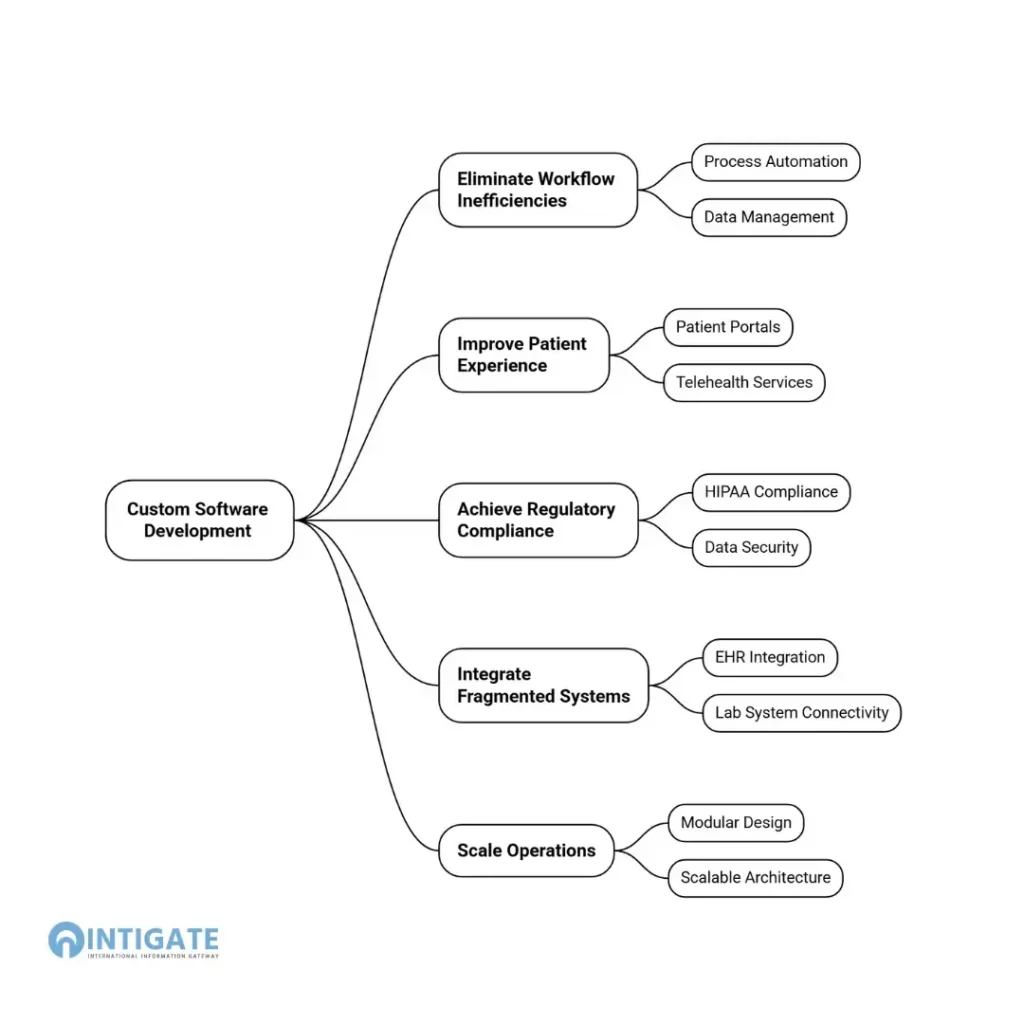
Eliminate Workflow Inefficiencies
Custom software directly targets and resolves operational bottlenecks by automating routine administrative tasks. This efficiency allows clinical staff to focus entirely on patient care delivery rather than navigating clunky interfaces.
Improve Patient Experience and Engagement
Modern patients demand seamless digital healthcare interactions. Tailored applications empower users to schedule appointments digitally, access lab results instantly, and communicate with their providers effortlessly.
Achieve Regulatory Compliance
Navigating the legal landscape of healthcare technology is immensely complex. Custom development ensures that robust encryption and stringent access controls are intrinsically baked into the core architecture, completely derisking compliance audits.
Integrate Fragmented Healthcare Systems
Data silos severely hinder accurate clinical decision-making. Custom software acts as a unifying digital bridge, securely connecting disparate legacy systems into a single source of truth.
Scale Operations Without Replacing Core Systems
As your medical organization grows, replacing foundational EHR systems can be prohibitively expensive. Bespoke solutions are highly scalable by design, allowing you to accommodate higher patient volumes seamlessly.
Types of Custom Healthcare Software Solutions We Develop
Electronic Health Record (EHR) and EMR Systems
We architect comprehensive Electronic Health Record (EHR) and EMR Systems that streamline complex patient data management and significantly improve clinical documentation accuracy.
Telemedicine and Virtual Care Platforms
Our secure Telemedicine and Virtual Care Platforms enable high-definition video consultations, expanding your clinical reach and facilitating remote patient care.
Patient Portals and Mobile Health Applications
We engineer intuitive Patient Portals and Mobile Health Applications designed to drive continuous patient self-service and proactive health engagement.
Hospital Management Systems (HMS)
Our robust Hospital Management Systems (HMS) centralize all administrative, financial, and clinical operations for large-scale, multi-facility medical organizations.
Remote Patient Monitoring Solutions
We develop Remote Patient Monitoring Solutions that track vital signs in real-time, enabling physicians to provide proactive care for chronic conditions.
Medical Billing and Revenue Cycle Management Software
Our specialized Medical Billing and Revenue Cycle Management Software automates complex claims processing and invoicing to accelerate your financial workflows.
Laboratory Information Management Systems (LIMS)
We build precise Laboratory Information Management Systems (LIMS) to heavily optimize biological sample tracking, data analysis, and laboratory reporting accuracy.
Pharmacy Management Software
Our Pharmacy Management Software streamlines massive inventory tracking, automated prescription fulfillment, and critical drug interaction alerting.
Clinical Decision Support Systems
We design Clinical Decision Support Systems that leverage massive data analytics to assist medical practitioners in making highly evidence-based diagnostic choices.
Healthcare CRM Solutions
Our Healthcare CRM Solutions help clinical providers manage ongoing patient relationships, track outreach campaigns, and drastically improve retention rates.
Healthcare Analytics and Reporting Platforms
We construct scalable Healthcare Analytics and Reporting Platforms that transform raw medical data into highly actionable insights for broad population health management.
Essential Features Every Custom Healthcare Software Solution Should Include
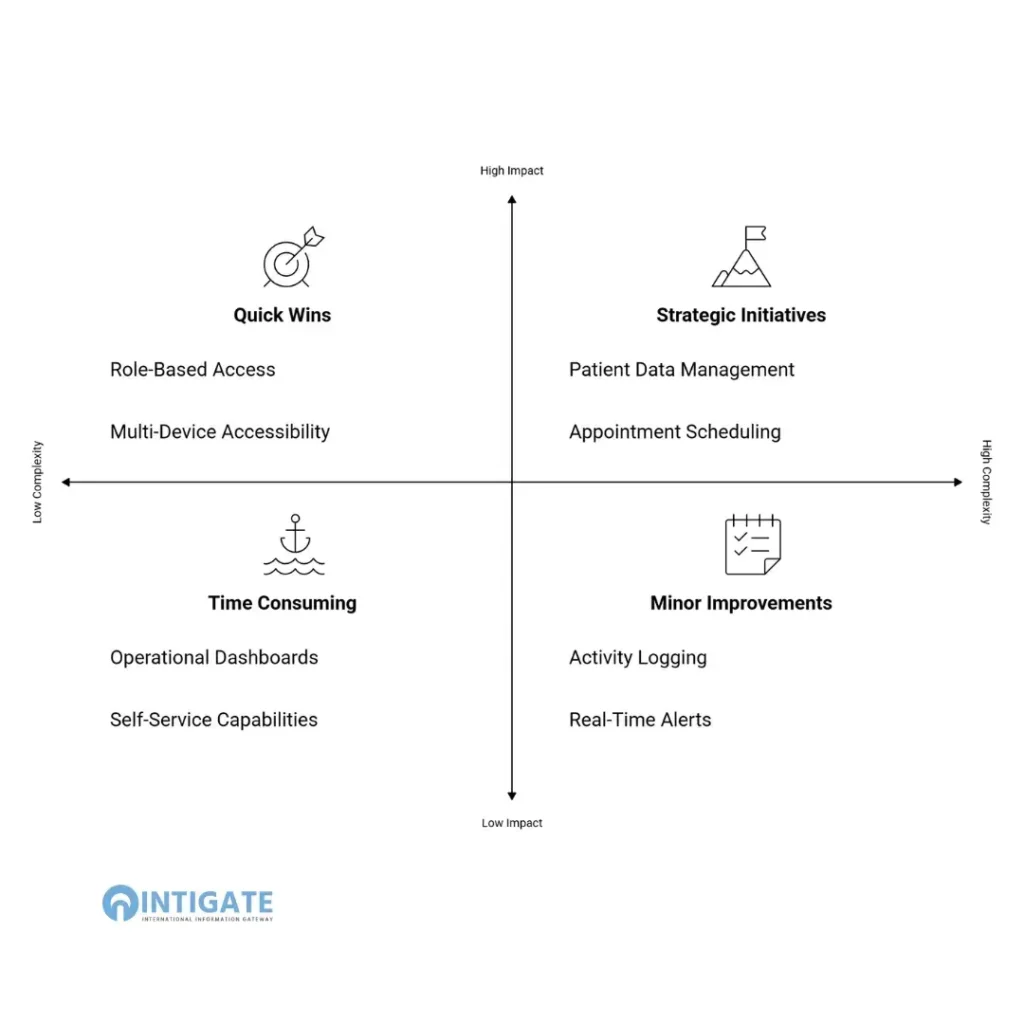
Role-Based Access Controls
Role-Based Access Controls ensure that medical staff members can only access the specific, highly sensitive patient data explicitly required for their designated job functions.
Secure Patient Data Management
Secure patient data management utilizes advanced cryptographic encryption protocols both at rest and in transit to fully protect protected health information (PHI).
Appointment Scheduling and Workflow Automation
Integrated appointment scheduling and workflow automation reduce clinical no-show rates and virtually eliminate manual administrative data entry errors.
Audit Trails and Activity Logging
Comprehensive audit trails and activity logging provide an immutable digital record of exactly who accessed or modified patient records, which is critical for compliance audits.
Real-Time Notifications and Alerts
Real-time notifications and alerts keep all relevant medical staff instantly informed about critical patient status updates, abnormal lab results, and urgent upcoming appointments.
Multi-Device Accessibility
Multi-device accessibility ensures the custom software functions flawlessly across desktop workstations, clinical tablets, and mobile smartphones.
Reporting and Operational Dashboards
Customizable reporting and operational dashboards provide hospital administrators with deep, real-time visibility into key performance indicators and clinical resource utilization.
Patient Self-Service Capabilities
Patient self-service capabilities, such as automated digital prescription refills and seamless intake forms, significantly reduce administrative call volumes.
Healthcare Compliance and Security Requirements You Cannot Ignore
HIPAA Compliance Requirements
For organizations operating in the US, strict adherence to the Health Insurance Portability and Accountability Act is mandatory. When stakeholders ask, Is My Software HIPAA Compliant, it means the application must enforce strict technical safeguards, physical security protocols, and robust data encryption to protect all electronic personal health information.
GDPR Considerations for Global Healthcare Providers
If your software processes health data for European citizens, compliance with the General Data Protection Regulation (GDPR) is essential. This mandates building features for seamless data portability, explicit consent management, and the right to erasure.
HL7 and FHIR Standards Explained
Health Level Seven International (HL7) and Fast Healthcare Interoperability Resources (FHIR) are foundational data frameworks. These standards facilitate the secure, standardized exchange of electronic health records between highly disparate medical applications.
Data Encryption and Secure Storage
Deploying impenetrable data encryption and secure storage protocols definitively protects your healthcare organization against devastating ransomware attacks and unauthorized external breaches.
Identity and Access Management
Identity and Access Management (IAM) systems rigorously verify all user credentials via multi-factor authentication, ensuring that strictly authorized personnel can access sensitive environments.
Disaster Recovery and Business Continuity Planning
A comprehensive disaster recovery and business continuity plan guarantees that vital patient care delivery is not interrupted during unexpected server failures or severe cyber incidents.
Why Interoperability Is the Foundation of Modern Healthcare Software
The structural ability of different information technology systems and software applications to securely communicate, exchange health data, and utilize the information that has been exchanged accurately.
Integrating With Existing EHR and EMR Systems
Modern medical software cannot operate in a technological vacuum. Integrating with existing EHR and EMR systems ensures that vital patient histories are universally accessible across all clinical departments.
FHIR-Based API Strategies
Leveraging FHIR-Based API Strategies empowers developers to construct lightweight, highly responsive system connections that securely pull and push health data across diverse clinical platforms.
Connecting Laboratories, Pharmacies, and Insurance Systems
Connecting laboratories, pharmacies, and insurance systems creates a highly unified digital ecosystem that drastically accelerates both clinical diagnosis and financial billing.
Common Integration Challenges and How to Avoid Them
Legacy system incompatibility represents a major technical hurdle. To avoid this, developers must conduct exhaustive API audits before engineering begins, ensuring entirely seamless data handoffs.
Custom Healthcare Software Development Process
- Discovery and Clinical Workflow Assessment: The development team maps your existing operational bottlenecks to define precise, highly technical software requirements.
- Compliance and Risk Assessment: The team rigorously evaluates your proposed architecture against regional regulations to proactively mitigate massive security risks.
- UX/UI Design for Patients and Providers: Designers architect highly intuitive digital interfaces meticulously tailored to the distinct needs of medical staff and patients.
- Architecture, Planning, and Technology Selection: Technical leads choose hyper-scalable tech stacks that easily support future API integrations and massive data volume growth.
- Agile Development and Sprint Delivery: Engineers build the software in iterative, agile cycles, allowing for continuous stakeholder feedback and rapid systemic adjustments. For a flawless execution of this step, partnering with experts in Software Development Services is highly recommended.
- Quality Assurance and Security Testing: QA testers execute rigorous penetration testing and quality assurance protocols to absolutely guarantee system integrity.
- Deployment and User Training: The team seamlessly launches the platform and provides highly comprehensive training to ensure immediate adoption rates.
- Post-Launch Maintenance and Continuous Improvement: Engineers deliver ongoing updates and performance optimizations to keep the software consistently operating at peak efficiency.
Emerging Trends Shaping Custom Healthcare Software Development
AI-Powered Clinical Workflows
AI-powered clinical workflows automate mundane data entry and heavily assist in preliminary diagnostics, significantly reducing widespread physician burnout.
Predictive Analytics for Population Health
Predictive analytics for population health enables proactive clinical interventions, accurately identifying high-risk patient demographics long before critical health events occur.
Remote Patient Monitoring Expansion
The remote patient monitoring expansion continues to accelerate rapidly, with wearable medical devices transmitting continuous health metrics directly to centralized physician dashboards.
Generative AI in Administrative Operations
Generative AI in administrative operations is radically streamlining documentation workflows, allowing organizations to draft highly accurate clinical notes and patient summaries in mere seconds.
Wearable and IoT Device Integrations
Wearable and IoT device integrations provide doctors with a deeply holistic view of patient health outside the clinic by seamlessly connecting fitness trackers and clinical-grade sensors.
Cloud-Native Healthcare Infrastructure
Transitioning to a cloud-native healthcare infrastructure provides the elastic scalability and robust data redundancy strictly necessary for highly reliable modern medical applications.
Custom Healthcare Software vs Off-the-Shelf Solutions: Which Is Right for Your Organization?
| Feature | Custom Healthcare Software | Off-the-Shelf Solutions |
|---|---|---|
| Cost structure | Higher initial investment, zero perpetual licensing fees | Lower upfront cost, high recurring monthly/annual seat fees |
| Time to deployment | Several months for tailored, ground-up development | Immediate or very rapid deployment |
| Workflow flexibility | Built exactly to match your specific operational needs | Highly rigid; it strictly requires adapting your internal processes |
| Compliance control | Absolute architectural control over all security protocols | Entirely reliant on the third-party vendor’s compliance standards |
| Integration capabilities | Limitless API integration capabilities with legacy systems | Strictly restricted to vendor-supported API integrations |
| Scalability | Infinitely scalable without accumulating extra user fees | Arbitrary software tiers often heavily limit users or charge per seat |
| Ownership of intellectual property | 100% legally owned by your healthcare organization | Fully legally owned by the third-party software vendor |
| Long-term ROI | Exceptional long-term ROI due to the elimination of licensing | Decreasing long-term ROI as user licenses heavily scale |
How Much Do Custom Healthcare Software Development Services Cost?
Key Factors Affecting Development Costs
The financial investment required depends heavily on specific business parameters. Key factors include the project’s overall complexity, the required compliance scope, and the exact number of necessary legacy integrations. Furthermore, complex user roles and permissions, the inclusion of AI and advanced functionality, and underlying cloud infrastructure requirements heavily dictate the budget.
Estimated Cost Ranges by Solution Type
- Healthcare MVP: Typically ranges from $40,000 to $75,000, focusing entirely on validating core functionalities. Understanding the MVP Development Cost for Startups is essential for initial budgeting.
- Telemedicine platform: Generally costs between $60,000 and $120,000, highly dependent on secure video streaming capabilities.
- Custom EHR solution: Often ranges from $150,000 to $300,000+, driven by extreme compliance and complex interoperability demands.
- Enterprise healthcare ecosystem: Can easily exceed $500,000, encompassing multi-facility legacy integrations and highly advanced analytics.
Hidden Costs Organizations Often Overlook
Organizations must rigorously budget for hidden costs, such as long-term server maintenance, annual third-party compliance audits, API licensing fees, and ongoing administrative staff training.
How to Choose the Right Healthcare Software Development Partner
Questions to Ask Before Hiring a Vendor
Always explicitly ask prospective development vendors about their verifiable experience handling sensitive medical data and precisely how they manage at-rest data encryption.
Red Flags That Indicate Risk
A vendor that aggressively refuses to sign a Business Associate Agreement (BAA) or demonstrates a severe lack of transparency regarding their security testing protocols represents a massive operational risk.
Healthcare Certifications and Experience to Verify
Ensure the engineering team possesses exceptionally deep, verifiable knowledge of HL7, FHIR, and regional health data laws. Choosing to work with the best software development companies in Dubai or your specific region guarantees vital local compliance expertise.
Evaluating Post-Launch Support Capabilities
Securing highly robust Service Level Agreements (SLAs) for post-launch support capabilities is essential to minimize highly disruptive clinical downtime.
Importance of Proven Healthcare Case Studies
Rigorously reviewing proven healthcare case studies decisively validates the vendor’s actual technical ability to deliver secure, highly scalable solutions that drive tangible operational improvements.
Build a scalable, fully compliant medical platform precisely tailored to your strategic needs.
Request a Project Estimate →Real Business Outcomes of Custom Healthcare Software
Improved Clinical Efficiency
Automating highly repetitive administrative tasks significantly improves clinical efficiency, easily allowing providers to safely see more patients daily.
Reduced Administrative Burden
By fully digitizing intake and billing workflows, a reduced administrative burden directly and substantially lowers ongoing operational overhead.
Higher Patient Satisfaction
Deploying highly intuitive digital portals leads to significantly higher patient satisfaction, actively fostering loyalty and driving demonstrably better health outcomes.
Better Regulatory Readiness
Engineering custom, highly secure architecture ensures significantly better regulatory readiness against constantly evolving global data privacy laws.
Long-Term Cost Optimization
Fully owning your proprietary software results in massive long-term cost optimization by eliminating perpetual third-party licensing fees.
Frequently Asked Questions
What are custom healthcare software development services?
Custom healthcare software development services involve creating tailored digital medical solutions, such as EHRs and telemedicine platforms, designed specifically to meet an organization’s unique clinical workflows, intricate integration needs, and strict regulatory compliance standards like HIPAA.
How long does healthcare software development take?
The development timeline varies heavily based on architectural complexity. A basic MVP typically takes 3 to 5 months to successfully launch. Comprehensive enterprise solutions, such as a highly custom EHR with complex legacy integrations, may require 9 to 18 months of intensive development.
How much does custom healthcare software cost?
Financial costs range significantly based on the project scope. A basic healthcare application might start around $40,000, whereas a fully integrated, enterprise-grade hospital management system can exceed $300,000. Compliance and complex interoperability requirements are massive cost drivers.
Is HIPAA compliance mandatory?
Yes, if your software technically handles, stores, or transmits Protected Health Information (PHI) within the United States, strict HIPAA compliance is legally mandatory. Failing to correctly implement the required technical safeguards can result in extremely severe financial penalties and massive reputational damage.
Conclusion: Building Healthcare Software That Supports Better Care Delivery
Custom healthcare software development services represent a highly strategic financial investment in the long-term future of your medical practice.
By actively eliminating highly rigid, off-the-shelf system constraints, healthcare organizations can rapidly deploy custom digital solutions that directly support significantly better care delivery and extreme operational excellence.
As established throughout this guide, prioritizing strict regulatory compliance, seamless digital interoperability, and highly robust architectural scalability is entirely non-negotiable for long-term clinical success.
Before selecting a technical vendor, we strongly encourage you to carefully assess your current structural technology gaps and deeply analyze your operational bottlenecks.
Partnering with an incredibly experienced development team guarantees your custom medical software will not only absolutely secure highly sensitive patient data but also effectively drive highly sustainable, long-term business growth and ROI for Intigate Technologies.