
You contact three software agencies for the same project. One quotes $30,000. Another says $140,000. The third comes back with $300,000.
Confusing? Absolutely.
But there is actually a clear reason behind every one of those numbers.
Once you understand it, you will be able to budget your project confidently, ask the right questions, and avoid getting overcharged or underprepared.
In this guide, we break down everything you need to know about custom software development cost in 2026, from average price ranges and what drives them, to hidden fees, pricing models, and how to get the most value for your investment.
Quick answer: Custom software development cost can range from $10,000 to $500,000+ depending on complexity, location of your team, and the features you need. Most small-to-medium projects land between $30,000 and $200,000.
What Is Custom Software Development?
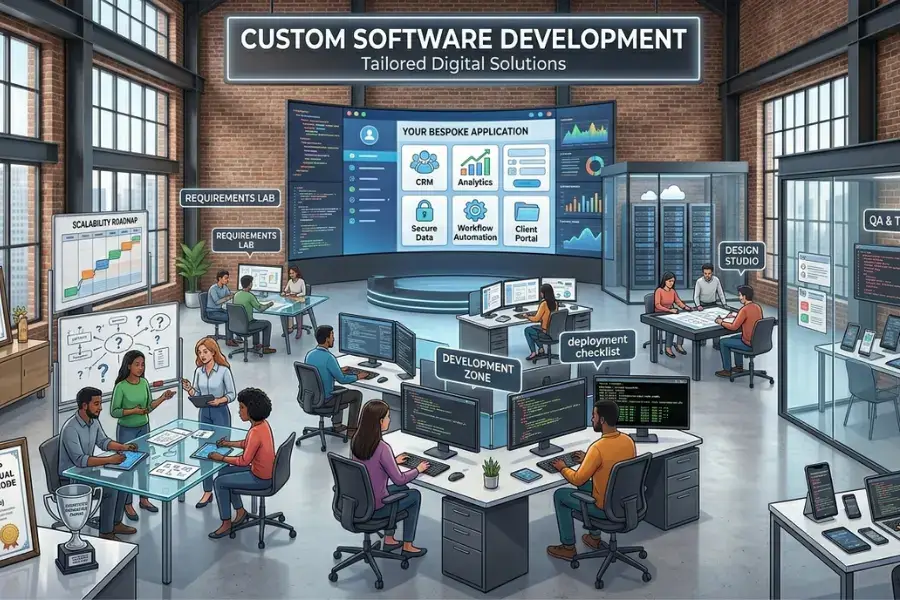
Custom software development is the process of designing and building a software solution from scratch, tailored to your exact requirements, workflows, and goals.
This is different from off-the-shelf software (like Salesforce, QuickBooks, or Shopify), which is a ready-made product that many businesses use with little to no modification.
Custom software is built only for you.
Why do businesses choose custom software?
- Off-the-shelf tools do not fit their unique processes
- They need tighter integration with existing internal systems
- They want full ownership of the product with no recurring licensing fees
- They are building a product or platform to sell to their own customers (SaaS)
According to a McKinsey study cited by industry researchers, top economic performers are more likely to build proprietary software assets than to buy off-the-shelf software because custom solutions give them a measurable competitive edge.
Average Custom Software Development Cost in 2026 (Quick Overview)
Here is a simple breakdown to give you a starting point before we go deeper:
| Project Type | Estimated Cost Range |
|---|---|
| Simple App / MVP | $10,000 – $50,000 |
| Small-to-Medium Web or Mobile App | $50,000 – $150,000 |
| Complex SaaS or Multi-Feature Platform | $150,000 – $300,000 |
| Enterprise Software | $300,000 – $500,000+ |
According to a 2026 survey by GoodFirms, custom software development costs range between $30,000 and $200,000 for most projects, with nearly 66% of companies falling in the $30,000–$100,000 range for small and medium projects.
For larger enterprise solutions, costs can go significantly higher.
SOLTECH reports that custom software solutions for mid-to-large businesses typically range from $100,000 to $400,000+.
These numbers are wide-ranging, and for good reason. Let us look at exactly what moves the price up or down.
Key Factors That Affect Custom Software Development Cost
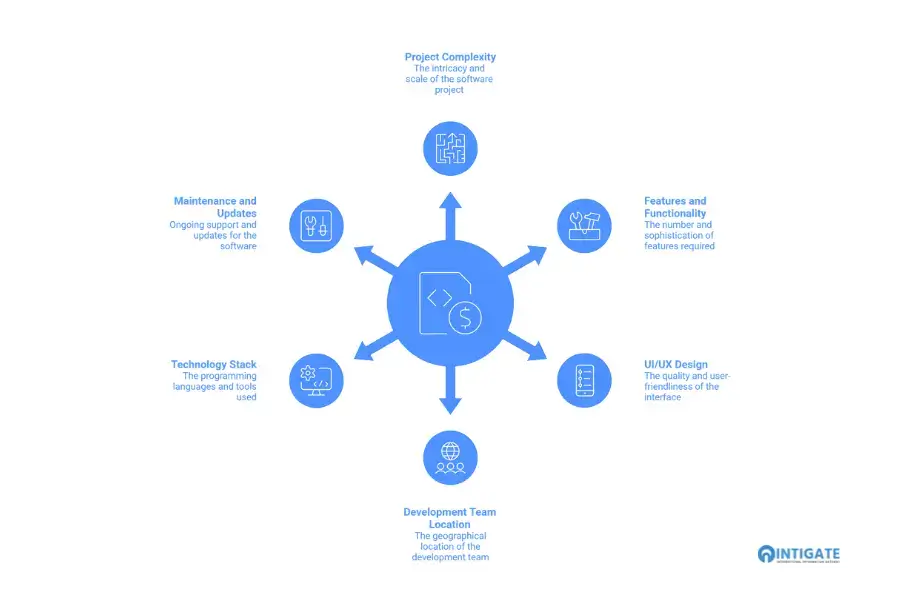
1. Project Complexity
The more complex your software, the more time it takes to build, and time is money in software development.
A basic internal tool with simple data input and reporting is far less expensive than a multi-tenant SaaS platform with AI recommendations, real-time analytics, and third-party integrations.
In 2026, features like AI, machine learning, and real-time data processing can increase development costs by 10-20% for mid-to-large projects.
2. Features and Functionality
Every feature costs time to design, build, test, and deploy. Common features that add to cost include:
- User authentication and role-based access control
- Payment gateway integrations (Stripe, Razorpay, PayPal)
- AI-powered modules (chatbots, recommendations, predictions)
- Third-party API integrations (CRMs, ERPs, logistics tools)
- Real-time notifications or live data feeds
- Multi-language and multi-currency support
Start by defining a Minimum Viable Product (MVP) – the smallest version of your product that delivers real value. This is the best way to control costs early and validate your idea before investing more.
3. UI/UX Design
Design is not just about making things look good.
Good UX directly impacts user adoption, retention, and revenue. Custom design work, including wireframing, prototyping, and responsive mobile design, adds to the cost but also adds significant long-term value.
A template-based design is cheaper. A fully custom design system built to match your brand takes more time and investment.
4. Development Team Location
Where your development team is based has one of the biggest impacts on your final cost.
Here is a current breakdown of average hourly rates by region:
| Region | Average Hourly Rate |
| India | $20 – $50/hr |
| Eastern Europe | $40 – $100/hr |
| Latin America | $40 – $80/hr |
| Western Europe | $80 – $150/hr |
| USA / Canada | $100 – $200/hr |
According to GoodFirms’ 2026 survey, 56.3% of software companies globally offer development at $20 – $50/hour, most of which are concentrated in Southeast Asia, Eastern Europe, and Latin America, where the quality is consistently high, but labour costs are lower.
Blended or hybrid teams, mixing senior engineers from high-cost regions with offshore developers, can reduce total costs by 20–30% without compromising quality.
💡 Want to know how much your specific project might cost? Talk to our experts at Intigate Technologies for a free cost estimate
5. Technology Stack
The technologies used to build your software affect both development speed and long-term maintenance costs.
Cloud-native architectures, microservices, blockchain integrations, and AI/ML frameworks all require specialised expertise.
Specialised skill sets come at a premium: AI/ML specialists typically add 12–15% to development costs, and fintech developers add 10–20% above standard rates.
6. Maintenance and Updates
This is the cost most businesses forget to plan for.
Your software does not stop costing money once it is launched. Ongoing maintenance, fixing bugs, updating integrations, adding new features, and keeping the system secure, runs approximately 15–25% of your initial development cost per year.
So if you build a $100,000 application, budget an additional $15,000 – $25,000 annually for upkeep.
Custom Software Development Cost by Region
Location is one of the most powerful levers you have to manage cost. Here is a more detailed look at what you can expect to pay when working with teams in different geographies:
| Region | Hourly Rate Range | Best For |
| India | $20 – $50/hr | Cost-effective, large talent pool, best for scalable projects |
| Southeast Asia | $25 – $50/hr | Affordable with growing quality standards |
| Eastern Europe | $40 – $100/hr | Strong technical talent, closer time zones to Europe |
| Latin America | $40 – $80/hr | Real-time collaboration for US-based companies |
| Western Europe | $80 – $150/hr | Premium quality, high accountability |
| USA / Canada | $100 – $200/hr | Mission-critical projects, highest cost |
India remains one of the most cost-effective markets globally, with over 5.2 million active developers, making it a popular choice for offshore development partnerships.
Eastern Europe delivers 35–50% cost savings versus Western markets while maintaining strong technical talent pools.
Cost Breakdown by Software Type
Web Applications
A standard web application think an internal business tool, a customer portal, or a booking system, typically costs between $30,000 and $150,000.
More advanced web apps with complex workflows and integrations can climb to $200,000+.
Mobile Apps
Cross-platform mobile apps (built with frameworks like React Native or Flutter) typically cost $40,000 to $150,000.
Native iOS or Android apps cost more. Cross-platform development can save 30–40% compared to building separate native apps for iOS and Android.
SaaS Platforms
Building a SaaS product, one that you will sell to other businesses or consumers, is a larger investment.
A functional SaaS platform with user management, billing, dashboards, and multi-tenancy usually ranges from $100,000 to $300,000+, depending on the number of features and integrations.
Enterprise Software
Enterprise-grade solutions, such as ERPs, CRMs, supply chain management systems, or healthcare platforms, are the most expensive category.
These projects typically start at $150,000 and go well beyond $500,000, depending on scope, compliance requirements, and legacy system integrations.
Hidden Costs You Should Know About
This is where most businesses get surprised. The quote you receive from a development agency is often just the build cost. Here are the additional costs you need to plan for:
Third-party API and service fees: Integrating tools like payment gateways, SMS services, mapping APIs, or data providers comes with ongoing subscription fees typically $2,000–$10,000 per integration, depending on complexity and usage volume.
Cloud hosting: Hosting your application on AWS, Google Cloud, or Azure is an ongoing monthly cost. Depending on traffic and data storage needs, this can range from a few hundred dollars per month to several thousand.
Security and compliance: If you operate in regulated industries (healthcare, fintech, edtech), you may need to invest in security audits, data encryption, GDPR, or HIPAA compliance, adding $5,000–$50,000+ to your project.
QA testing and documentation: Many businesses underestimate this. Project management, quality assurance, and documentation overhead can consume 23–48% of the total project budget.
Scaling costs: As your user base grows, so does your infrastructure cost. Plan for this from day one; it is much cheaper to architect for scale early than to re-engineer later.
Custom Software Pricing Models
Before you sign a contract, make sure you understand which pricing model you are working with.
Fixed Price Model
You agree on a fixed scope and a fixed price upfront. Best for: small to medium projects with well-defined requirements.
Pros: Predictable budget, lower financial risk.
Cons: Inflexible scope changes are expensive. Any new requirement becomes a separate “change order.”
Hourly / Time-and-Materials Model
You pay for actual hours worked. Best for: projects where requirements may evolve or change over time.
Pros: Flexible, transparent, and allows ongoing adjustment.
Cons: Final cost can vary significantly from early estimates.
Dedicated Team Model
You hire a dedicated team of developers who work exclusively on your project, typically on a monthly retainer.
Best for: long-term product development, SaaS platforms, and ongoing feature development.
Pros: Deep product knowledge, faster iteration, high team cohesion.
Cons: Higher monthly commitment, requires active project management from your side.
How to Reduce Custom Software Development Cost
You do not need to compromise on quality to manage your budget.
Here is what actually works:
Start with an MVP.
Build only what is necessary for launch. Validate with real users. Then invest in the next phase based on actual feedback and data. This approach reduces your initial risk dramatically.
Prioritise your feature list.
Separate must-have features from nice-to-have ones. You can always add features in phase two.
Choose the right technology partner.
Outsourcing to a quality team in India or Eastern Europe can reduce costs by 40–70% compared to US or Western European rates without sacrificing quality, if you choose the right partner.
Define requirements clearly before development begins.
Unclear requirements are one of the biggest drivers of cost overruns. Invest time in a proper discovery and scoping phase upfront; it always pays off.
Avoid scope creep.
Every new feature added mid-project costs more than it would have if planned from the start. Stick to your agreed scope and manage additions through a structured change process.
Custom Software vs Off-the-Shelf: Cost Comparison
| Factor | Custom Software | Off-the-Shelf |
| Upfront Cost | High ($30K–$500K+) | Low (subscription-based) |
| Long-term Cost | Lower (no licensing fees) | Higher (recurring subscriptions) |
| Flexibility | Very High | Limited |
| Scalability | Fully scalable | Depends on vendor |
| Ownership | Full ownership | You own nothing |
| Fit for your business | Perfect fit | Generic fit |
| Competitive advantage | High | Low |
The key takeaway: off-the-shelf software has a lower entry cost but can become more expensive over time, especially when you factor in multiple subscriptions, customisation limitations, and the productivity cost of working around a tool that does not quite fit.
Research cited by SumatoSoft notes that nearly 70% of top economic performers use custom software to differentiate themselves from competitors, and it shows in their results.
Real-Life Cost Examples
Let us look at some realistic project examples to give you a sense of what different budgets can get you.
Example 1: Healthcare Patient Portal (~$75,000–$100,000)
A mid-sized clinic wants a custom patient portal where users can book appointments, view their medical history, receive reports, and communicate with doctors.
This involves user authentication, a booking engine, a document management system, and HIPAA-compliant data storage.
At an offshore rate of $30–$50/hour with a team of 5, this project takes approximately 6–8 months.
Example 2: E-Commerce Platform with Custom Logic (~$100,000–$150,000)
A manufacturer wants a B2B e-commerce platform with custom pricing rules per customer, an inventory management system, and ERP integration.
Standard solutions like Shopify cannot handle their custom pricing logic. A fully custom-built platform with these capabilities lands in the $100K–$150K range.
Example 3: AI-Powered SaaS Platform (~$200,000–$350,000)
A startup is building a SaaS product that uses machine learning to analyse user behaviour and deliver personalised recommendations.
This requires a complex backend, a data pipeline, ML model integration, a multi-tenant architecture, and a subscription billing system. Factor in 12–18 months of development and a team of 6–8 people.
Is Custom Software Worth the Investment?
For the right business, absolutely yes.
The global custom software development market was valued at $43.21 billion in 2024 and is projected to grow to $334.49 billion by 2034, expanding at a CAGR of 22.71%.
This explosive growth reflects how seriously businesses are taking custom software as a strategic investment.
From an ROI perspective, companies investing in custom software solutions can achieve returns of 200% to 400% within a few years, according to research highlighted by Forrester.
Custom software also drives operational efficiency.
McKinsey research shows that automation through custom software can improve productivity by 20–35% across affected departments.
The initial investment is real. But so is the long-term value, when the software is planned well, built right, and maintained properly.
Frequently Asked Questions
How much does custom software development cost?
Custom software development cost ranges from $10,000 for a simple MVP to $500,000+ for enterprise-grade solutions. Most small-to-medium projects fall between $30,000 and $200,000. The final cost depends on complexity, features, team location, and technology stack.
Why is custom software so expensive?
Custom software requires a full team of developers, designers, QA engineers, and project managers, all working together to build something tailored specifically to your needs. Unlike off-the-shelf software, there is no shared cost across thousands of customers. Every hour of work is dedicated to your project.
How long does it take to build custom software?
A simple app or MVP can take 2–4 months. A medium-complexity web or mobile application typically takes 4–8 months. Enterprise-level platforms can take 12–24 months, depending on scope.
Can I reduce my custom software development cost?
Yes. Start with an MVP, prioritise features, choose an offshore or nearshore development team, and define your requirements clearly before development begins. These steps alone can reduce your budget by 30–60%.
What is the best pricing model for custom software development?
It depends on your project. Fixed price works best for small, well-defined projects. Time-and-materials is better for complex or evolving projects. A dedicated team model is ideal for long-term product development.
Conclusion
Custom software development is not cheap, but it is also not a mystery. Once you understand the factors that drive cost, you can make smart decisions that balance quality, speed, and budget.
To recap the key points:
- Most projects fall between $30,000 and $200,000 for small to medium solutions
- Team location is one of the biggest cost drivers – offshore teams in India and Eastern Europe offer strong quality at significantly lower rates
- Hidden costs like maintenance, hosting, and compliance can add 20-40% on top of the build cost
- Starting with an MVP is the single best way to reduce risk and initial investment
- The ROI of well-built custom software is substantial, often 200-400% over a few years
The right software, built the right way, becomes one of the most valuable assets your business owns.