
- The best travel software development company combines GDS integration depth, PCI DSS 4.0.1 compliance, and verifiable travel-specific delivery history, not just a broad service menu.
- Global travel gross bookings are projected to reach approximately $1.67 trillion in 2025, with online bookings approaching 65% of that volume by 2026.
- The global GDS market was valued at roughly $13 billion in 2023 and was forecast to exceed $14.4 billion in 2024, which is why GDS fluency belongs at the top of any evaluation checklist.
- New PCI DSS 4.0.1 cardholder data requirements became mandatory on March 31, 2025, making payment compliance a non-negotiable filter when shortlisting a travel technology partner.
- Intigate Technologies has delivered 15+ travel projects for clients that have collectively raised over $50 million in funding, with engineering based in India and an on-ground presence across the UAE, Kuwait, and Qatar.
Finding the best travel software development company starts with a harder question than most procurement checklists ask.
Can this team normalize a GDS response schema, or have they only ever built a booking screen and called it a travel experience?
Global travel gross bookings are projected to reach roughly $1.67 trillion in 2025, with online bookings approaching 65% of that volume by 2026 (Phocuswright, 2026).
That growth has pulled a wave of generalist agencies into the travel space without the platform depth the sector actually requires.
In the UAE specifically, Intigate Technologies already operates as a Best Travel Software Development Company, building booking systems and AI-driven recommendation engines for regional travel operators.
This guide sets out the evaluation criteria that separate a genuine travel technology partner from a generalist shop, covering core services, GDS and compliance requirements, realistic cost ranges, and the questions worth asking before you sign a contract.
Get a structured evaluation of your GDS, payment compliance, and delivery requirements before you shortlist a vendor.
Talk to a Travel Tech Consultant →What Makes a Travel Software Development Company Different
Travel software development company: a technology partner that engineers booking, distribution, and back-office systems specifically for airlines, OTAs, tour operators, and hospitality brands, rather than building general-purpose business applications.
That distinction shows up fastest in how a team handles supplier data. A generalist dev shop can build a clean booking interface in a few sprints.
A travel-specific partner can explain, in technical detail, how it normalizes inconsistent response schemas from Amadeus versus Sabre before that data ever reaches your UI: different field naming conventions, different availability-caching behavior, different error-handling for oversold inventory.
That second capability is what actually prevents a booking engine from breaking under peak-season load, and it’s the fastest way to separate a real travel partner from one that’s learning travel on your project timeline.
The same gap shows up in compliance and in distribution technology.
Travel platforms handle cross-border payment data and passenger personal information simultaneously, which means PCI DSS is not optional.
Airlines and their technology partners are also mid-transition toward NDC (New Distribution Capability), an IATA-developed data standard that lets airlines distribute richer, more personalized content directly through API rather than through legacy GDS-only channels.
A partner who can’t speak to where NDC fits in your integration roadmap is behind the infrastructure shift already underway in the sector.
Core Services a Travel Technology Partner Should Offer
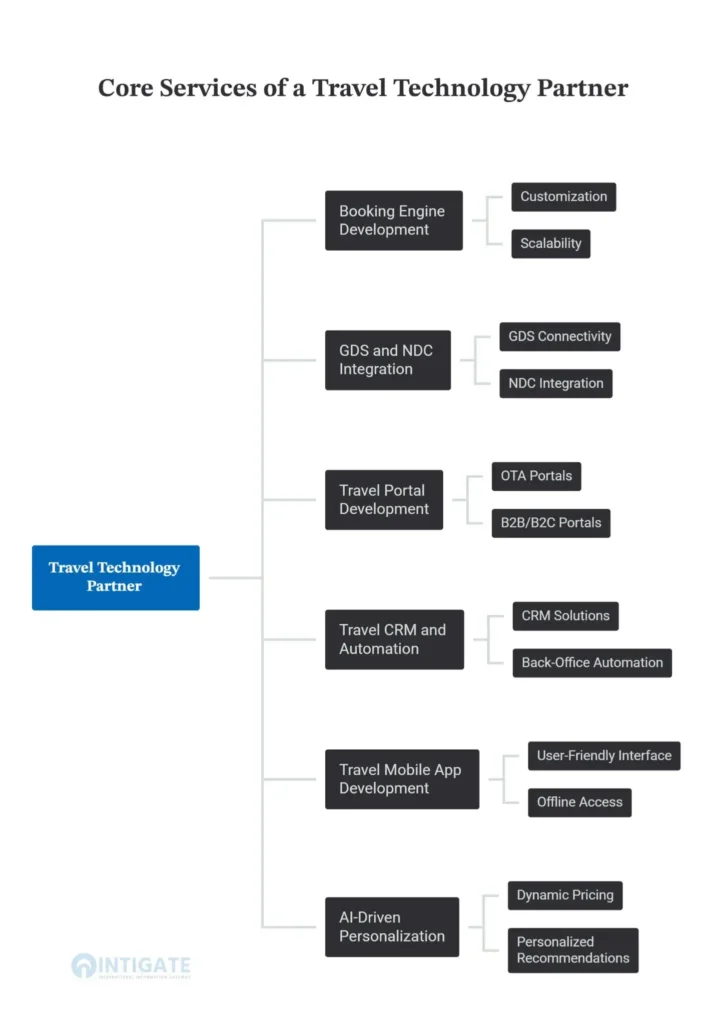
A credible travel software development company should be able to speak fluently to each of the following, not just list them on a services page.
- Booking engine development: real-time search, availability, and reservation flows for flights, hotels, packages, and transfers.
- GDS and NDC integration: connecting your platform to global supplier inventory through both legacy GDS channels and newer NDC-based airline content.
- OTA and B2B/B2C travel portal development: multi-supplier marketplaces and agent-facing booking tools.
- Travel CRM and back-office automation: the operational layer tour operators and DMCs use to manage bookings, suppliers, and commissions.
- Travel mobile app development: iOS and Android apps for booking, itinerary management, and mobile check-in.
- AI-driven personalization and dynamic pricing: recommendation engines and pricing models that respond to demand signals in real time.
Global Distribution System (GDS): a computerized network, such as Amadeus, Sabre, or Travelport, that connects travel agents and booking platforms to real-time airline, hotel, and car rental inventory.
The global GDS market was valued at approximately $13 billion in 2023 and is forecast to exceed $14.4 billion in 2024 (Statista, 2024), underscoring how central this infrastructure remains even as direct-booking and NDC channels grow.
Once you know what a partner should be able to build, the next step is confirming it against a real project history rather than a services page. That’s what the framework below is for.
How to Evaluate the Best Travel Software Development Company for Your Project
Use this sequence before signing any contract, in order.
- Request GDS-specific case studies. Ask for a project that involved Amadeus, Sabre, or Travelport integration, not a generic booking UI screenshot.
- Confirm PCI DSS 4.0.1 readiness. Any platform that touches cardholder data needs to meet the new requirement set by March 31, 2025 (PCI Security Standards Council, 2025). If a vendor cannot speak to this directly, treat it as a warning sign.
- Ask for a documented delivery process. Sprint cadence, escalation paths, and handoff procedures should be explainable in specifics, not described only as “Agile.”
- Check for a discovery phase. A partner that quotes a fixed price without first mapping your business model and integration requirements is guessing, not scoping.
- Run a short paid pilot sprint. A two-to-three-week paid engagement before a long-term commitment reveals more about communication style and technical depth than any portfolio review.
Generalist Web Agency vs. Dedicated Travel Software Partner
Use this comparison to separate a generalist agency from the best travel software development company for your specific build.
| Criteria | Generalist Agency | Travel Partner |
|---|---|---|
| GDS / NDC integration | Limited or none | Documented, named suppliers |
| PCI DSS 4.0.1 compliance | Often unaddressed | Built in from discovery |
| Peak-season concurrency | Untested at scale | Designed for traffic spikes |
| Domain vocabulary (OTA, DMC…) | Learned during project | Fluent from first call |
PNR (Passenger Name Record): the record created in a GDS or airline reservation system that holds a traveler’s full itinerary, contact details, and booking history under a single reference. A vendor who can’t explain how your platform reads or writes PNR data hasn’t built a real GDS integration before.
What Intigate Technologies Has Actually Built, and What to Verify Yourself
Applying this framework transparently means being specific about where a vendor’s proof stops and where discovery needs to start. Here’s that line for Intigate Technologies.
Intigate Technologies is a custom software development company headquartered in Noida, India, with a regional presence across the UAE, Kuwait, and Qatar.
On the travel and mobility side, Intigate has delivered 15 or more projects for clients that have collectively raised over $50 million in funding, holds ISO certification, and has built apps downloaded more than 4 million times.
Two of those projects are named directly rather than described in the abstract.
UrbanGo, a crypto-based green commuting app, ranked No. 1 on the Google Play Store in 2017–18 and holds a 4.5 rating from over 1,500 users. Beep Beep, a UK taxi booking platform, was built around a surge-free pricing model.
Both are mobility and ground-transport builds, not GDS-integrated airline or hotel booking platforms — which means the proven, verifiable strength here is travel and mobility app engineering broadly.
If your project specifically requires GDS or NDC integration work, that piece isn’t demonstrated by this portfolio and should be scoped and verified directly during discovery, with named supplier references, before you sign anything.
A partner willing to draw that line clearly is a better signal than one who lets a broad “travel technology” claim imply GDS depth it hasn’t shown.
That multi-market footprint still matters for travel businesses operating across India and the GCC, where regional compliance and client-facing presence are harder to fake than a services page claim.
Intigate Technologies is also an official Meta Business Partner for WhatsApp Business API integrations, which is directly relevant for travel platforms that use WhatsApp for booking confirmations, itinerary updates, or customer support — a use case increasingly common as travel businesses move support interactions off email.
Discuss your GDS, compliance, and delivery requirements with Intigate Technologies’ technical team.
Book a Free Scoping Call →Travel Software Development Cost
Cost depends primarily on three factors: the number of third-party integrations, the business model, and the depth of customization.
A functional MVP with core booking flows and a single GDS integration typically takes a few months to build.
A full-featured platform with multi-supplier integration, dynamic pricing, and compliance layers takes considerably longer, since payment compliance and supplier normalization both add engineering time that a simple booking UI does not require.
For a rough benchmark, travel app builds industry-wide typically fall between $20,000–$80,000 for a basic-feature app and $100,000–$200,000 for a larger product with advanced functionality and deeper integrations.
That range is a starting reference point for app-level builds specifically, not a quote — a full OTA platform with GDS and NDC integration sits above it, and your actual number depends on the integrations and compliance scope above.
Where the team is based materially changes the economics of that build.
If you are comparing delivery locations before comparing vendors, our breakdown of best countries for outsourcing software development covers how India, Eastern Europe, and Latin America each serve different project profiles, and why only 34% of executives now cite cost reduction as their primary reason for outsourcing, down from 70% in 2020.
For a closer look at what India-based engineering specifically costs relative to US and Western European rates, see our guide to custom software development in India.
If you are shortlisting across a wider offshore vendor pool rather than a single region, our best offshore software development companies comparison applies the same evaluation framework used above, extended to enterprise vendors like Accenture and TCS.
These cost drivers hold whether you are comparing the best travel software development company options in India or shortlisting GCC-based teams directly.
Frequently Asked Questions
What does a travel software development company do?
A travel software development company builds booking engines, GDS/NDC integrations, travel portals, and back-office systems specifically for airlines, OTAs, tour operators, and hospitality brands. Unlike generalist software firms, these partners engineer for supplier data normalization, peak-season traffic, and travel-specific payment compliance from the outset.
How much does travel software development cost, and how long does it take?
Cost depends on the number of supplier integrations, business model, and customization depth. A basic travel app runs roughly $20,000–$80,000 as an industry-typical benchmark; a larger, more advanced build runs $100,000–$200,000 or more once GDS and NDC integration, dynamic pricing, and compliance layers are added, which also extends the timeline from a few months to considerably longer.
Should I build custom travel software or use an off-the-shelf booking platform?
Off-the-shelf platforms launch faster and cost less upfront, but they limit customization and often carry per-transaction licensing fees that compound as you scale. Custom development costs more initially but removes those licensing ceilings and lets you own the full technology stack.
How do I evaluate a travel software development company before signing a contract?
Request GDS-specific case studies, confirm PCI DSS 4.0.1 readiness, ask for a documented delivery process, check for a discovery phase before pricing, and run a short paid pilot sprint before committing to a long-term contract.
Does Intigate Technologies build travel software for the UAE and GCC market specifically?
Yes. Intigate Technologies delivers travel and tourism software development from its India engineering base with an on-ground presence in the UAE, Kuwait, and Qatar, combining India-based delivery economics with regional compliance and client-facing support in the GCC.
Has Intigate Technologies built GDS-integrated booking platforms specifically?
Intigate’s named travel and mobility work — including UrbanGo and Beep Beep — is in ground-transport and commuting apps rather than GDS-integrated airline or hotel booking systems. If your project requires GDS or NDC integration, ask for named supplier references during discovery rather than assuming it from the broader travel portfolio.
How do I know if I have found the best travel software development company for my project?
The best travel software development company will let you verify GDS-specific case studies, confirm PCI DSS 4.0.1 readiness in writing, and agree to a short paid pilot sprint before any long-term contract. If a vendor resists any of those three requests, keep looking.
Conclusion
The best travel software development company for your project is the one that can prove GDS or NDC integration depth, payment compliance readiness, and a documented delivery process — in that order — before you sign anything, and that draws a clear line between what it has built and what needs to be scoped fresh for your case.
The market backs up why this rigor matters: global travel gross bookings passed an estimated $1.67 trillion in 2025, and the GDS infrastructure underpinning most of that volume is a multi-billion-dollar market in its own right.
A partner that treats compliance and supplier integration as an afterthought is not equipped for that scale.
Run the evaluation framework above against your top two or three candidates, request a paid pilot sprint, and use the cost and delivery-model comparisons here to set realistic expectations before your project begins.