

- The best countries for outsourcing software development depend on your project type, not a single global ranking — India leads on scale and cost-efficiency, Eastern Europe on regulated/complex R&D, Latin America on real-time collaboration.
- The global IT outsourcing market reached an estimated $638.65 billion in 2026, according to Mordor Intelligence, reflecting how central outsourcing has become to enterprise software delivery.
- Cost is no longer the primary driver: only 34% of executives now cite cost reduction as their main reason for outsourcing, down from 70% in 2020, according to Deloitte’s Global Outsourcing Survey.
- India remains a top-three global destination for business services delivery alongside the United States and Poland, according to Deloitte’s 2025 Global Business Services Survey.
- Total cost of ownership — not the hourly rate alone — should determine your final decision; the cheapest quote is rarely the lowest true cost.
Choosing among the best countries for outsourcing software development now depends less on which country has the lowest rate card and more on which one aligns with your project’s risk profile.
The global IT outsourcing market reached an estimated $638.65 billion in 2026 (Mordor Intelligence, 2026), and the reason behind that growth has evolved: only 34% of executives now cite cost reduction as their primary reason for outsourcing, down from 70% in 2020 (Deloitte Global Outsourcing Survey, 2024).
Today, access to skilled talent, faster delivery, and specialized expertise matter just as much as cost.
This shift changes how businesses should evaluate outsourcing destinations. A country that was once the obvious low-cost choice may no longer be the best strategic fit if your project demands AI/ML expertise, strong compliance standards, or seamless real-time collaboration.
Whether you’re building a new product or scaling an existing platform with reliable software development services, choosing the right outsourcing partner starts with understanding your actual business priorities.
This guide first provides a practical decision-making framework, followed by a country-by-country comparison based on verified data, so you can choose the destination that truly fits your project, rather than relying on generic rankings.
Get a free 30-minute scoping call where we map your project requirements against the right delivery model and country fit — before you commit to a vendor.
Talk to an Outsourcing Strategist →How to Choose the Right Outsourcing Country (Not Just the “Best” One)
Outsourcing destination fit: The right country for software development outsourcing is determined by your project type, required time zone overlap, compliance needs, and total cost of ownership — not by a single universal ranking.
Before comparing countries, define what you’re actually outsourcing. A company building an MVP in eight weeks has different requirements than an enterprise modernizing a 15-year-old core banking platform, yet both searches land on the same generic “best countries” articles.
Match Your Project Type to the Right Profile
- MVP or early-stage product: prioritize speed and flexibility; a smaller, agile team that can pivot quickly matters more than a 500-person delivery center.
- Enterprise modernization or large-scale build: prioritize bench depth; the ability to scale a team from five to fifty engineers without losing delivery quality becomes the binding constraint.
- Ongoing staff augmentation: prioritize time zone overlap and communication style, since augmented developers sit inside your daily standups, not a separate project team.
- Specialized or regulated work (fintech, healthtech): prioritize compliance maturity and domain-specific experience over cost.
The Five Factors That Decide the Outcome
- Talent depth and specialization: Does the country produce engineers in your specific stack and domain — cloud-native, AI/ML, legacy modernization, mobile — not just general headcount?
- Cost-to-skill ratio: The lowest hourly rate and the best value are rarely the same number; a $20/hour developer needing three rework cycles costs more than a $35/hour developer who doesn’t.
- Time zone overlap: How many working hours can your team and theirs share for standups and unblocking issues, versus relying entirely on async documentation?
- English proficiency and communication culture: Miscommunication, not cost, is the most commonly cited reason outsourcing relationships fail.
- Data security and compliance posture: GDPR alignment, ISO 27001 certification, and IP protection frameworks vary significantly by country and matter disproportionately for fintech, healthcare, and enterprise SaaS.
Best Countries for Outsourcing Software Development — Full Comparison
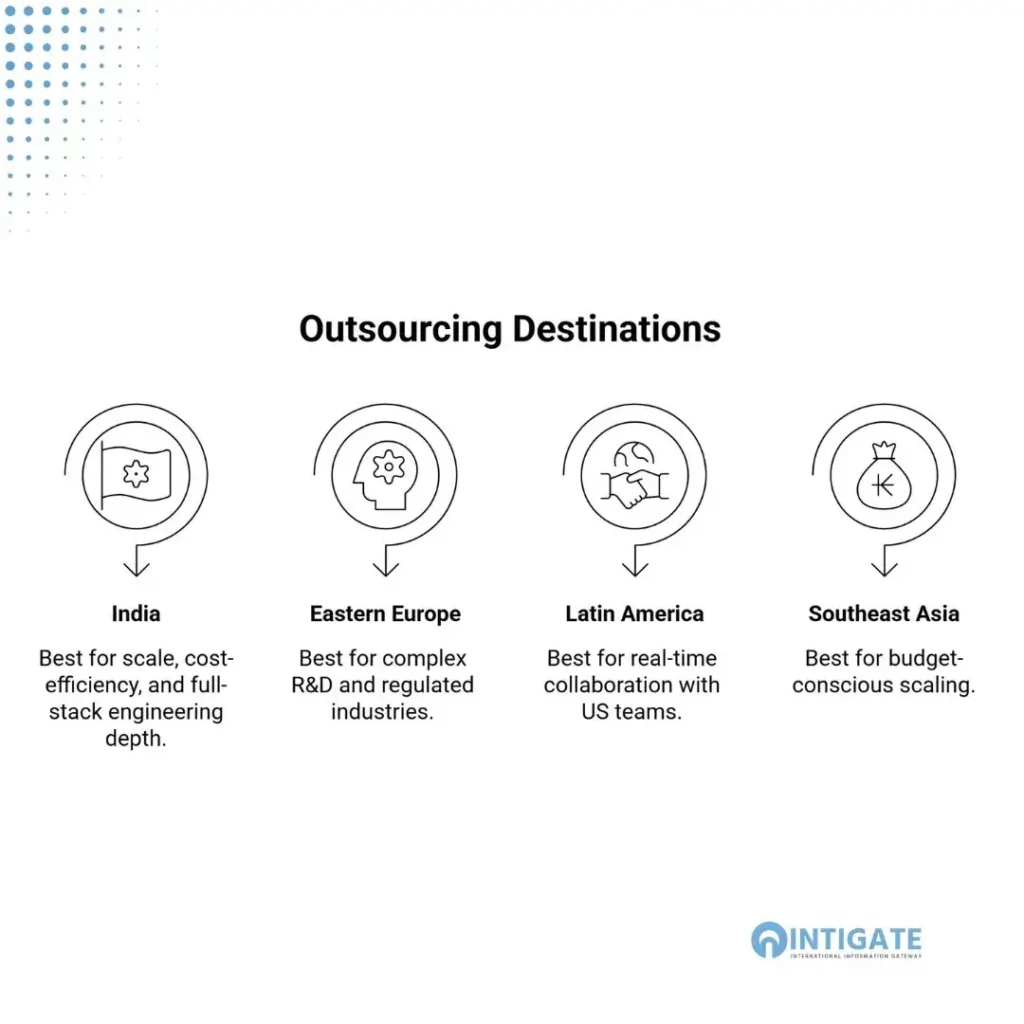
India: Best for Scale, Cost-Efficiency, and Full-Stack Engineering Depth
India outsourcing fit: India is the best-positioned country for enterprise-scale software development outsourcing, combining a 5 million-plus engineering workforce with a broad technical range across cloud, AI/ML, and enterprise platform development.
India ranks among the top three global destinations for business services delivery, alongside the United States and Poland, and has consistently held that position across multiple years of Deloitte’s Global Business Services Survey.
That ranking reflects more than headcount; it reflects sustained delivery maturity across finance, IT, and customer-facing functions for organizations with more than 30 countries represented in the survey base.
What distinguishes India today is its technical range. The ecosystem has matured well beyond legacy maintenance and back-office support into cloud-native development, AI/ML implementation, DevOps, and enterprise platform engineering.
Indian outsourcing partners routinely serve North American, European, and GCC clients within the same delivery model, which means most established providers already operate inside Western business norms — structured sprint planning, documented QA processes, formal handoffs — rather than adapting to them mid-engagement.
Typical hourly rates: $15–$50/hour depending on seniority and tech stack, with meaningful variation between Tier 1 hubs (Bangalore, Pune, NCR) and Tier 2 cities.
Best for: Enterprise application development, cloud migration and modernization, ongoing staff augmentation, AI and data engineering, and projects requiring rapid team scaling without sacrificing technical range.
Watch for: Vendor quality varies widely across the market, from globally certified delivery centers to lower-tier shops, which makes partner due diligence more consequential here than in smaller, more homogenous markets.
Eastern Europe (Poland, Romania, Ukraine): Best for Complex R&D and Regulated Industries
Eastern Europe outsourcing fit: Eastern Europe is the strongest region for software development outsourcing requiring great algorithmic skill, EU-level data compliance, and regulated-industry experience, particularly fintech and healthtech.
Poland holds a position in Deloitte’s top-three global business services destinations alongside India and the United States (Deloitte, 2025), reflecting sustained enterprise confidence in the region’s delivery maturity rather than a cost-driven trend.
As an EU member, Poland also provides GDPR-aligned data protection by default; a structural advantage for fintech and healthcare projects handling EU user data that doesn’t require additional compliance engineering.
Ukraine’s developer market, despite regional instability, remains one of the deepest in Central and Eastern Europe for engineers capable of owning difficult systems: backend architecture, infrastructure design, and complex product problem-solving rather than commodity feature work. Romania adds strength in enterprise software, cybersecurity, and fintech, supported by EU-funded digital infrastructure investment.
Typical hourly rates: $30–$75/hour for senior engineers, varying by country and city tier.
Best for: Fintech and regulated-industry builds, complex R&D, cybersecurity-sensitive projects, and teams needing EU-level compliance with partial time zone overlap into European business hours.
Watch for: Rates run meaningfully higher than Asia, and regional economic or political volatility — particularly relevant for Ukraine – requires a distributed delivery strategy rather than single-location dependency.
Latin America (Mexico, Brazil, Colombia): Best for Real-Time Collaboration With US Teams
Latin America outsourcing fit: Latin America is the strongest nearshore option for US companies that require daily real-time collaboration, offering four to eight hours of working-day overlap depending on the specific country and US time zone.
For North American companies, the core advantage isn’t cost — it’s synchronization. A nearshore team working Mexico City or Bogotá hours is effectively online during a US workday, rather than handing off work asynchronously overnight.
Mexico benefits from USMCA trade alignment and deep familiarity with US business culture. Brazil has built a strong concentration of fintech, healthtech, and SaaS engineering talent in São Paulo, with particular strength in Java, Python, and mobile development.
Colombia has emerged as a competitive mid-cost option with solid English proficiency and growing nearshore demand from US startups.
Typical hourly rates: $35–$85/hour for senior engineers, with rates trending upward due to high US demand outpacing regional supply.
Best for: Agile product development requiring daily real-time collaboration, UX/UI-heavy builds, and teams whose workflow depends on pair programming or rapid feedback loops rather than documented async handoffs.
Watch for: Rates have held firm rather than compressed in recent years, narrowing the cost gap with Eastern Europe; certain markets, notably Argentina, carry currency and economic volatility worth confirming directly with any prospective partner.
Southeast Asia (Vietnam, Philippines): Best for Budget-Conscious Scaling
Southeast Asia outsourcing fit: Southeast Asia offers the most cost-competitive entry point for software development outsourcing, with Vietnam strong in technical delivery and the Philippines distinguished by exceptional English proficiency.
The Philippines scored 90 out of 100 on English proficiency in the Ataraxis Global Outsourcing Talent Index 2026, compared to 60 out of 100 for India, and ranked first overall on that index ahead of Malaysia and India — driven by English fluency, Western cultural alignment, and competitive pricing with lower attrition rates. Vietnam has moved from a low-cost alternative to a genuine outsourcing destination in its own right, supported by government incentives including corporate tax reductions for tech investment.
Typical hourly rates: $15–$60/hour, among the most cost-competitive in the global market.
Best for: Budget-sensitive builds with flexible timelines, QA and communication-heavy roles (Philippines specifically), and companies prioritizing cost savings over deep architectural specialization.
Watch for: Time zone gaps with US and European clients are significant, requiring strong asynchronous workflows and documentation discipline to avoid delivery bottlenecks.
Country Comparison at a Glance
| Region/Country | Avg. Hourly Rate (Senior) | Talent Pool | English Proficiency | US/UK Time Zone Overlap | Best-Fit Project Type |
|---|---|---|---|---|---|
| India | $15–$50 | 5M+ engineers | 60/100 (Ataraxis, 2026) | Low (offshore, async-heavy) | Enterprise builds, scaling, AI/cloud |
| Poland | $25–$75 | Top-3 GBS destinations globally (Deloitte, 2025) | High | Moderate (EU hours) | Fintech, regulated industries, R&D |
| Ukraine | $30–$55 | Large, established base | High | Moderate (EU hours) | Complex backend, infrastructure |
| Mexico | $35–$80 | Large, US-aligned | High | High | Agile, real-time collaboration |
| Brazil | $35–$85 | Large, fintech-heavy | Moderate–High | Moderate | Fintech, mobile, SaaS |
| Vietnam | $15–$60 | Fast-growing | Moderate | Low | Budget-conscious scaling |
| Philippines | $15–$45 | Large, service-oriented | 90/100 (Ataraxis, 2026) | Low | QA, frontend, communication-heavy roles |
Hourly rates reflect senior-level engineering talent and vary by city tier, specialization, and engagement model; junior and mid-level rates typically run 30–50% lower. Sources: Ataraxis Global Outsourcing Talent Index 2026; Deloitte 2025 Global Business Services Survey.
Why India Leads in Most Outsourcing Scenarios
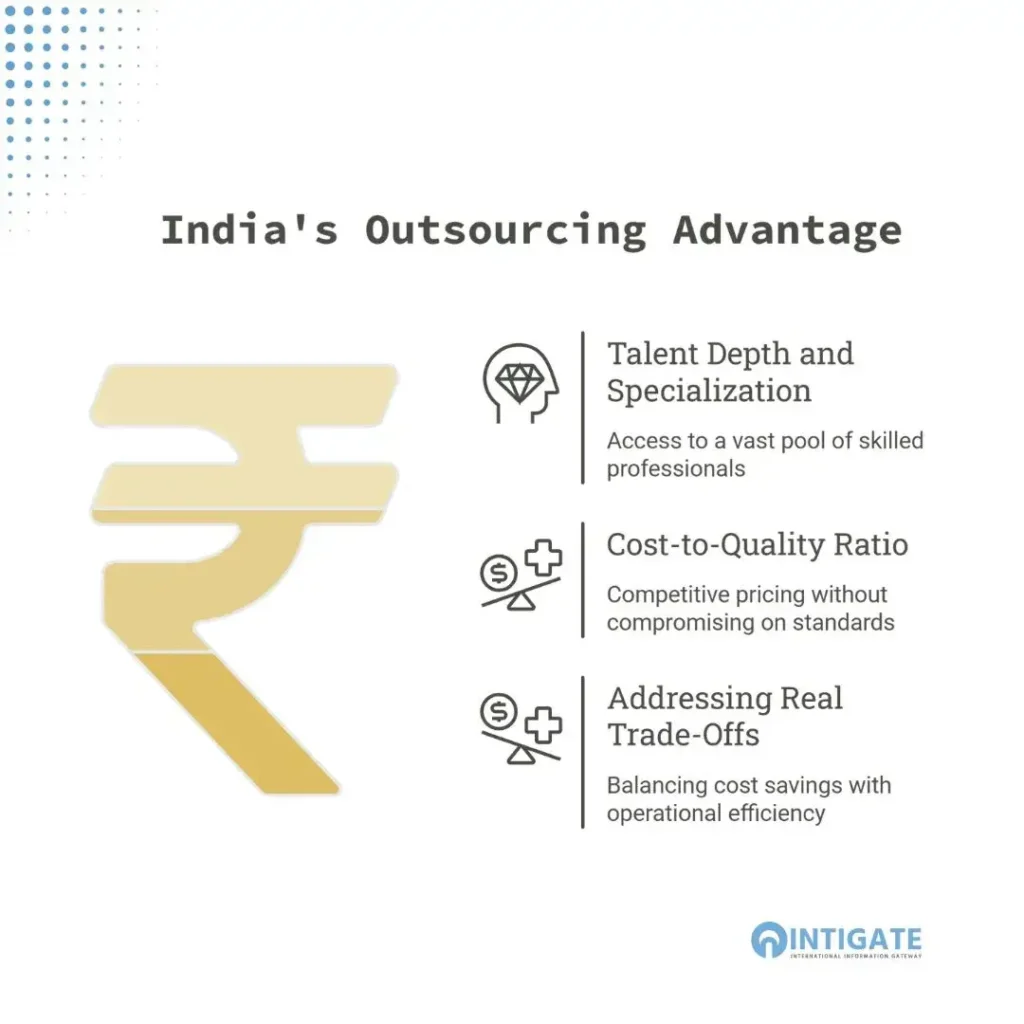
Looking at the comparison above, India’s advantage isn’t that it undercuts every region on price — Vietnam and the Philippines can beat it on commodity work, and Poland matches it on Deloitte’s top-tier global business services ranking.
India’s advantage is that it’s the only region combining genuine cost efficiency with full-range technical depth and the talent volume to scale without hitting a ceiling.
Talent Depth and Specialization
The scale of India’s engineering workforce means buyers aren’t forced to trade cost for capability — both exist within the same market.
Cloud architecture, DevOps, AI/ML implementation, and compliance-aware development all sit inside the same talent pool that also supports high-volume, cost-efficient delivery, a combination that’s genuinely difficult to find concentrated in one location.
Cost-to-Quality Ratio
Compared against Eastern Europe’s $30–$75/hour senior rates or Latin America’s $35–$85/hour, India’s $15–$50/hour range delivers a meaningfully lower total cost of ownership for most project types, without the architecture-quality trade-off that lower-cost Southeast Asian markets sometimes carry on complex builds.
Addressing the Real Trade-Offs
Time zone overlap with US and UK business hours is limited, which means projects benefit from deliberately structured async workflows and defined overlap windows rather than assumed real-time availability.
Vendor quality also varies considerably across India’s market, so partner due diligence — track record, certifications, and client references – should be a non-negotiable part of vendor selection, not a formality.
Offshore vs. Nearshore vs. Onshore: Which Model Fits Your Project
Offshore outsourcing: Partnering with a distant country — India and Southeast Asia are the primary offshore destinations for US and European companies — for the lowest cost but minimal real-time overlap.
Nearshore outsourcing: Partnering with a country in a similar time zone — Latin America for US companies, Eastern Europe for Western European companies — for moderate cost with real-time collaboration through shared working hours.
Onshore outsourcing: Hiring within your own country for the same time zone, shared business culture, and no language barrier, at a cost that runs close to internal hiring and eliminates most of the financial advantage of outsourcing.
Many companies now run hybrid models: a nearshore team handling product-facing work that needs tight feedback loops, paired with an offshore team handling high-volume development, QA, or maintenance where async workflows are less of a constraint.
Software Development Outsourcing Cost by Country (2026 Data)
Software development outsourcing cost: Offshore development (India, Southeast Asia) typically runs $15–$50/hour; nearshore development (Latin America, Eastern Europe) runs $30–$85/hour; onshore development (US, Western Europe) runs $90–$200+/hour.
At the project level, a simple MVP or small application typically falls in the $10,000–$50,000 range regardless of region, while complex enterprise applications with custom architecture commonly exceed $100,000–$500,000, and the regional rate differential compounds significantly at that scale.
On a 1,000-hour enterprise engagement, the gap between an Indian offshore team at $30/hour and a US onshore team at $150/hour isn’t a marginal saving; it’s the difference between a $30,000 and a $150,000 line item for the same scope of work.
For a detailed breakdown of how project complexity, team composition, and engagement model affect pricing, see our guide to custom software development cost.
Three factors matter more than the headline hourly rate:
- Engagement model: Fixed-price contracts suit well-defined scope; time-and-materials suits evolving requirements but needs tighter budget monitoring.
- Seniority mix: A team weighted toward senior engineers costs more per hour but typically reduces rework and accelerates delivery, often lowering the effective cost per shipped feature despite the higher rate card.
- Hidden overhead: Project management, QA infrastructure, and tooling costs are sometimes bundled into the hourly rate and sometimes billed separately — this should be clarified before signing, not discovered in the first invoice.
Red Flags to Avoid When Choosing an Outsourcing Country or Partner
A strong country choice can still produce a poor outcome with the wrong partner.
No verifiable track record: A reputable partner can point to specific case studies, client references, and project portfolios in your industry, not just generic claims of experience.
Missing security certifications: ISO 27001, SOC 2, or equivalent data protection certifications signal that a vendor takes IP and data security seriously; their absence, particularly for fintech or healthcare projects, is a legitimate disqualifier.
Vague IP ownership terms: Contracts should explicitly state that all code, documentation, and IP transfer to you upon payment.
Unrealistic rate quotes: A quote significantly below the regional average for the stated scope of work is rarely a genuine saving — it usually signals junior talent billed at mid-level rates, or scope that will expand once the project starts.
Poor communication during the sales process: How a vendor communicates before you’ve signed anything is the best available preview of how they’ll communicate once you have.
Send us your shortlist and project scope — we’ll give you an honest read on fit, even if the answer is that we’re not the right match.
Get a Free Vendor Fit Review →Frequently Asked Questions
What is the cheapest country to outsource software development to?
Vietnam and India offer the lowest entry-level rates, often starting around $15/hour for junior developers. However, the cheapest hourly rate rarely produces the lowest total project cost once rework, communication overhead, and quality variance are factored in.
Is India still the best country for outsourcing software development in 2026?
For most project types — enterprise builds, cloud and AI work, ongoing staff augmentation – yes. India ranks among the top three global business services destinations (Deloitte, 2025) and combines a 5 million-plus engineering workforce with rates significantly below Eastern Europe or Latin America.
What’s the difference between offshore and nearshore outsourcing?
Offshore outsourcing partners with a distant country for the lowest cost but minimal time zone overlap. Nearshore outsourcing partners with a nearby country for moderate cost, with real-time collaboration through shared working hours.
How much does it cost to outsource a software development project?
A simple MVP typically costs $10,000–$50,000 regardless of region. Complex enterprise applications commonly exceed $100,000–$500,000, with the regional rate (offshore vs. nearshore vs. onshore) significantly affecting the final figure at that scale.
What questions should I ask before choosing an outsourcing partner?
Confirm their track record in your industry, request client references, verify security certifications (ISO 27001, SOC 2), clarify IP ownership terms in the contract, and ask how they structure communication and reporting across time zones.
Conclusion
The best countries for outsourcing software development aren’t ranked the same way for every company — the right destination depends on your project type, required collaboration model, and compliance needs more than any single rate card.
India leads for most enterprise and scaling scenarios on the strength of its talent depth and cost-to-quality ratio, while Eastern Europe and Latin America win out for regulated industries and real-time collaboration, respectively.
Cost reduction is no longer the primary reason organizations outsource; talent access and delivery speed now matter just as much.
Use the framework in this guide to match your project to the right country, then apply the same scrutiny to vendor selection that you applied to country selection.
If you’re ready to move from research to a shortlist, Intigate Technologies can help you scope the right delivery model for your project.